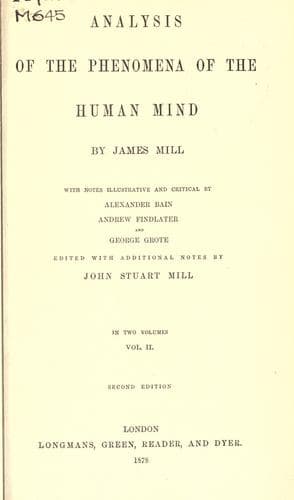
Analysis of the Phenomena of the Human MindMill, James
PhilosophyPhilosophy
Analysis of the Phenomena of the Human Mind
Mill, James
Psychology
[Editor's footnote 44: There is some need for additional elucidation
of the class of complex ideas distinguished (under the name of Mixed
Modes) by Locke, and recognised by the author of the Analysis, as
"put together in a great degree at our discretion;" as "those which
the mind forms arbitrarily," so that "the ideas of which they are
composed are more or less numerous according to pleasure, and each
man of necessity forms his own combination." From these and similar
phrases, interpreted literally, it might be supposed that in the
instances given, a centaur, a mountain of gold, comfort, meanness,
fear, courage, temperance, ignorance, republic, aristocracy,
monarchy, piety, good manners, prudence--the elements which
constitute these several complex ideas are put together
premeditatedly, by an act of will, which each individual performs
for himself, and of which he is conscious. This, however, happens
only in cases of invention, or of what is called creative
imagination. A centaur and a mountain of gold are inventions:
combinations intentionally made, at least on the part of the first
inventor; and are not copies or likenesses of any combination of
impressions received by the senses, nor are supposed to have any
such outward phenomena corresponding to them. But the other ideas
mentioned in the text, those of courage, temperance, aristocracy,
monarchy, &c., are supposed to have real originals outside our
thoughts. These ideas, just as much as those of a horse and a tree,
are products of generalization and abstraction: they are believed to
be ideas of certain points or features in which a number of the
clusters of sensations which we call real objects agree: and instead
of being formed by intentionally putting together simple ideas, they
are formed by stripping off, or rather, by not attending to, such of
the simple sensations or ideas entering into the {143} clusters as
are peculiar to any of them, and establishing an extremely close
association among those which are common to them all. These complex
ideas, therefore, are not, in reality, like the creations of mere
imagination, put together at discretion, any more than the complex
ideas, compounded of the obvious sensible qualities of objects,
which we call our ideas of the objects. They are formed in the same
manner as these, only not so rapidly or so easily, since the
particulars of which they are composed do not obtrude themselves
upon the senses, but suppose a perception of qualities and sequences
not immediately obvious. From this circumstance results the
consequence noticed by the author, that this class of complex ideas
are often of different composition in different persons. For, in the
first place, different persons abstract their ideas of this sort
from different individual instances; and secondly, some persons
abstract much better than others; that is, take more accurate notice
of the obscurer features of instances, and discern more correctly
Public-domain text, read in full here on John Shaqi.
Reviews
Reviews
No reviews yet
Be the first to share your thoughts on this work.
Elsewhere in the archive
Join the Discussion
Join the discussion
Sign in to leave a comment or review.
Sign InorCreate an account