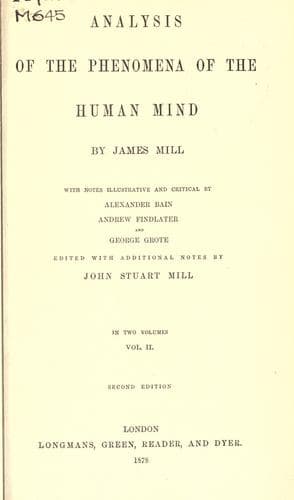
Analysis of the Phenomena of the Human MindMill, James
PhilosophyPhilosophy
Analysis of the Phenomena of the Human Mind
Mill, James
Psychology
what are those in which all the instances agree. This important
subject will be more fully entered into when we reach that part of
the present work which treats of the ideas connected with General
Terms.--_Ed._]
{144} SECTION II.
NOUNS ADJECTIVE.
As the purpose of language is to denote sensations and ideas; to
mark them for our own use, or to give indication of them to our
fellow men; it is obvious that the names of sensations and ideas are
the fundamental parts of language. But as ideas are very numerous,
and the limits of the human memory admit the use of only a limited
number of marks or names, various contrivances are employed to make
one name serve as many purposes as possible.
Of the contrivances for making the use of each word as extensive as
possible, we have already adverted to one of great importance; that
of arranging ideas in classes, and making one name stand for each
individual of the class. When the classes are large, one word or
mark serves to name or indicate many individuals.
But when, for the sake of economizing names, those classes have been
made as large as possible, we often find occasion for breaking them
down into smaller parcels, or sub-classes, and speaking of these
sub-classes by themselves.
An example will render what is here expressed sufficiently plain.
The term sound, is the name of a large class of ideas or sensations;
for it is equally the name of both; the sound of thunder, the sound
of a cannon, the whistling of the wind, the voice of a man, the
howling of a dog, and so on.
{145} Among these sounds I perceive differences; some affect me in
one way, and I wish to mark them as doing so; some affect me in
another way, and I wish to mark them as affecting me in that
particular way.
It is obvious that names might be invented for these subordinate
classes, to mark such of them as we have occasion to mark; and the
cases are numerous, in which this is the expedient adopted. Thus the
term animal is the name of a large class. But we have occasion to
speak apart of various portions of this class, to all the more
important of which portions, we have given particular names. Horse
is the name of one portion, man of another, sheep of another, and so
of the rest.
There is, however, another mode of naming subordinate classes; a
mode by which the use of names is greatly economized, and of which
the utility is therefore conspicuous.
Public-domain text, read in full here on John Shaqi.
Reviews
Reviews
No reviews yet
Be the first to share your thoughts on this work.
Elsewhere in the archive
Join the Discussion
Join the discussion
Sign in to leave a comment or review.
Sign InorCreate an account