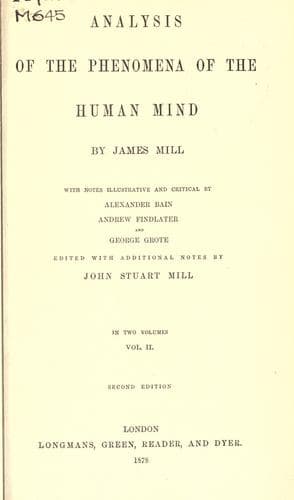
Analysis of the Phenomena of the Human MindMill, James
PhilosophyPhilosophy
Analysis of the Phenomena of the Human Mind
Mill, James
Psychology
The word action, when thus invented, and used, is afterwards applied
metaphorically to motions which do not originate in the moving body,
as when we say the action of a sword; and also to certain processes
of the mind, which, as they are accompanied with the feeling we call
effort, resembling that which accompanies the voluntary motions, are
sometimes classed along with them, and, by an extension of the
meaning of the word, receive the name of actions. In this manner,
remembering, computing, comparing, even hearing, and seeing, are
denominated actions.
2. In applying the term Acting, or the terms expressive of the
several kinds of acting, the Time the action is a material
circumstance. The grand divisions of time are the Past, the Present,
and the Future. There is great utility in a short method of marking
these divisions of time in conjunction with the mark of the action.
This is effected by the Tenses of Verbs.
3. When the name of an act is applied to an agent the agent is
either the person speaking, the person spoken to, or some other
person. The word denoting {154} the action is, by what are called
the Persons of the verb, made to connote these diversities. Thus
_amo_ notes the act, and connotes the person speaking as the actor;
_amas_ notes the act, and connotes the person spoken to, as the
actor; _amat_ notes the act, and connotes some person, as the actor,
who is neither the person speaking, nor the person spoken to.[46]
[Editor's footnote 46: There is here a fresh instance of the
oversight already pointed out, that of not including in the function
for which general names are required, their employment in
Predication. Amo, amas, and amamus, cannot, I conceive, with any
propriety be called names of actions, or names at all. They are
entire predications. It is one of the properties of the kind of
general names called verbs, that they cannot be used except in a
Proposition or Predication, and indeed only as the predicate of it:
(for the infinitive is not a verb, but the abstract of a verb). What
else there is to distinguish verbs from other general names will be
more particularly considered further on.--_Ed._]
4. When the names of actions are applied to agents, they are applied
to one or a greater number. A short method of connoting this grand
distinction of numbers is effected by the marks of the Singular and
Plural number. Thus _amo_ notes the act, and connotes one actor;
_amamus_ notes the act, and connotes more than one actor.
Public-domain text, read in full here on John Shaqi.
Reviews
Reviews
No reviews yet
Be the first to share your thoughts on this work.
Elsewhere in the archive
Join the Discussion
Join the discussion
Sign in to leave a comment or review.
Sign InorCreate an account