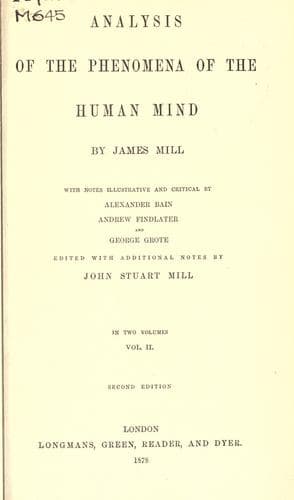
Analysis of the Phenomena of the Human MindMill, James
PhilosophyPhilosophy
Analysis of the Phenomena of the Human Mind
Mill, James
Psychology
A billiard-ball affects my senses, in a particular manner. On
account of this, I call it round; and the term round is ever after a
mark to me of a portion of the sensations which I derive from it. It
affects me in another manner. I call it on that account white, and
the term white is to me a mark of this other mode in which it
affects me: and in the same manner as I call it white, round, on
account of such and such sensations, I call it Moving, on account of
certain other sensations, of which the term Moving is to me a
perpetual mark.
{152} The manner of affecting me on account of which I call it
moving, I learn from experience to be peculiarly entitled to my
regard. I find that it is a mode of affecting me, which belongs to
almost all bodies; and I find that upon this attribute of theirs the
greatest part of my interesting sensations depend. I am therefore
deeply concerned in the knowledge of motions; and have the strongest
inducement to divide them into such classes as may in the highest
degree facilitate that knowledge.
Motions are divided in a great variety of ways for a variety of
purposes. Sometimes we divide them according to their subjects.
Thus, the motion of a bird is one class of motions; the motion of a
horse another; so the motion of a serpent, the motion of an arrow,
the motion of a wheel. At other times we form classes of motions
according to the manner. Thus we have running, flying, rolling,
leaping, staggering, throwing, striking, and so on.
Of all the classifications of motions, however, that which deserves
the greatest attention is the distinction of them into the motions
which originate within the moving body, and those which originate
without it. Of the motions which originate within the moving body,
the principal are the living motions of animals. We find, also, that
of all the motions of animals, those of men are the most important
to men. The motions of men are divided into a great number of
classes. On account of one set of motions we call a man walking; on
account of another sort we call him running; another, writing;
another, dancing; another, fencing; another, boxing; another,
building; and so on. We have also frequent occasion for a name which
shall {153} embrace all these motions of men. For this purpose the
word Acting is employed: and the term Action denotes any of the
motions, which originate within a man as the moving body. It is no
objection to this account of the use of the word action, that it is
sometimes employed in cases in which the motion is not the principal
object of attention; as in the act of singing, or that of speaking.
Here, though it is not the motion, but the effect of the motion,
which is the object of attention to the hearer, the act of the
singer or speaker is not the less truly a motion.
Public-domain text, read in full here on John Shaqi.
Reviews
Reviews
No reviews yet
Be the first to share your thoughts on this work.
Elsewhere in the archive
Join the Discussion
Join the discussion
Sign in to leave a comment or review.
Sign InorCreate an account