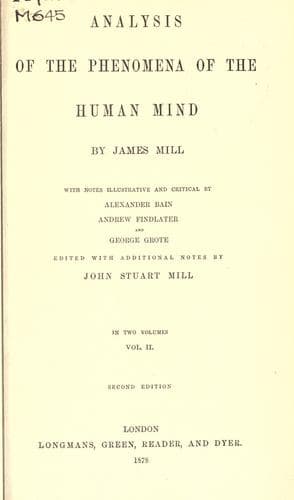
Analysis of the Phenomena of the Human MindMill, James
PhilosophyPhilosophy
Analysis of the Phenomena of the Human Mind
Mill, James
Psychology
It is necessary to explain a little this convenience; and the
explanation will have another advantage, that it will still farther
illustrate the manner in which Predication serves the great purpose
of marking the Order of ideas in a Train.
If the sensations or ideas in a train were to be marked as merely so
many independent items, the mode of marking the order of them would
be simple; the order of the marks itself might suffice. If this, for
example, were the train; smell of a rose, sight of a rat, sound of a
trumpet, touch of velvet, prick of a pin, these names placed in
order might denote the order of the sensations.
In the greater number of instances, however, it is necessary to mark
the train as the train of somebody; and for this purpose additional
machinery is required. Suppose that the train I have to mark is the
train of John, a train of the sensations of John; what are the marks
for which I shall have occasion? It is first of all evident that I
must have a mark for John, and a mark for each of the sensations.
Suppose it is my purpose to represent John as having a sensation by
each of his senses, sight, smell, &c., how must I proceed? I have
first the word John, for the mark of the person; and I have the word
seeing, for the mark of the sensation. But beside the marks, "John,"
"seeing," I have occasion for a mark to show that I mean the mark
"seeing" to be applied to the mark "John," and not to any other. For
that purpose I use the word "is." I say "John is seeing," and the
first sensation of John's train is now sufficiently {173} denoted.
In the same manner I proceed with the rest; John is smelling, John
is tasting, John is hearing, John is touching.
But I have often occasion to speak not only of John's present
sensations, but of his past or his future sensations; not of John as
merely now seeing, hearing, &c., but as having been, or as going to
be, the subject of these sensations. The _Copula_ may be so
contrived as most commodiously to connote the main distinctions of
Time: not merely to mark the connection between the two marks which
form the subject and the predicate of the proposition, but to mark,
along with this, either past, or present, or future, Time. Thus, if
I say John is seeing, the copula marks present time along with the
peculiar connection between the predicate and the subject; if I say
John was seeing, it connotes past time; if I say John will be
seeing, it connotes future time.
Public-domain text, read in full here on John Shaqi.
Reviews
Reviews
No reviews yet
Be the first to share your thoughts on this work.
Elsewhere in the archive
Join the Discussion
Join the discussion
Sign in to leave a comment or review.
Sign InorCreate an account