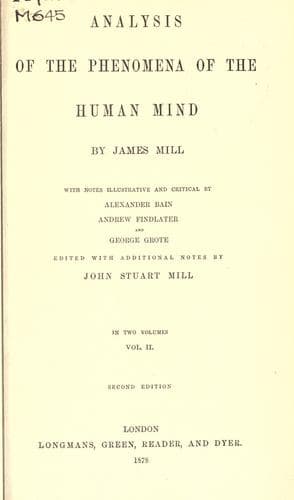
Analysis of the Phenomena of the Human MindMill, James
PhilosophyPhilosophy
Analysis of the Phenomena of the Human Mind
Mill, James
Psychology
As, in explaining the functions of verbs, there appeared a
convenience in the contrivance by which they were made to connote
three Manners; first, when no reference is made to any thing which
is previously spoken of; secondly, when a reference is made to
something which is previously spoken of; thirdly, when a reference
is made to the will of one of the PERSONS; it will now be seen that
there is the same convenience in making the _Copula_ connote these
references by a similar contrivance. Thus, when we speak of a man
having sensations, we may speak of him as having them or as not
having them, in consequence of something previously spoken of; or we
may speak of him as having them in consequence of our will. It is,
therefore, useful, that the _Copula_ should {174} have moods as well
as tenses. The same thing may be said of persons and numbers; of
which no illustration seems to be required.
We come next to an observation respecting the _Copula_, to which the
greatest attention is due. In all Languages, the Verb which denotes
EXISTENCE has been employed to answer the additional purpose of the
_Copula_ in Predication. The consequences of this have been most
lamentable. There is thus a double meaning in the _Copula_, which
has produced a most unfortunate mixture and confusion of ideas. It
has involved in mystery the whole business of Predication; the grand
contrivance by which language is rendered competent to its end. By
darkening Predication, it has spread such a veil over the phenomena
of mind, as concealed them from ordinary eyes, and allowed them to
be but imperfectly seen by those which were the most discerning.
In our own language, the verb, TO BE, is the important word which is
employed to connote, along with its Subject, whatever it be, the
grand idea of EXISTENCE. Thus, if I use the first person singular of
its indicative mood, and say, "I am," I affirm EXISTENCE of myself.
"I am," is the equivalent of "I am EXISTING." In the first of these
expressions, "I am," the mark "am" involves in it the force of two
marks; it involves the meaning of the word "existing," and the
marking power or meaning of the _Copula_. In the second expression
"I am existing," the word "am" ought to serve the purpose of the
_Copula_ only. But in reality its connotation of EXISTENCE still
adheres to it; and whereas the expression ought to consist of the
three established parts of a Predication; 1, the _subject_ {175}
"I;" 2, the _predicate_ EXISTING; and 3, the _copula_; it in reality
consists of, 1, the subject "I;" 2, the predicate EXISTING; 3, the
_Copula_; which signifies, 4, EXISTING, over again.
Public-domain text, read in full here on John Shaqi.
Reviews
Reviews
No reviews yet
Be the first to share your thoughts on this work.
Elsewhere in the archive
Join the Discussion
Join the discussion
Sign in to leave a comment or review.
Sign InorCreate an account