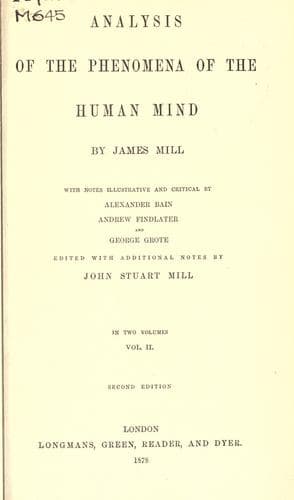
Analysis of the Phenomena of the Human MindMill, James
PhilosophyPhilosophy
Analysis of the Phenomena of the Human Mind
Mill, James
Psychology
[Findlater's footnote 53: The account of predication above given is
in conformity with the phenomena of the family of languages known as
the Indo-European. Logicians, in fact, in treating of this subject
have had almost exclusive regard to Greek and Latin and the literary
languages of modern Europe, which are all of one type. It might
therefore be presumed that the theory thus formed would be found not
to fit in all its parts when applied to languages of an altogether
different structure. The mental process must doubtless be the same
in all; but the words that express the several parts may be used in
new and unprecedented ways. Were naturalists to construct a scheme
of the animal organism without ever having seen any other animals
than those of the vertebrate type, the theory would certainly fail
in generality; certain organs or functions would be set down as
essential to animal existence which acquaintance with other classes
of creatures shows can be quite well dispensed with. Similarly, the
current theory of predication, when viewed in the light of a wider
and deeper knowledge of the organism of speech, seems to attach an
exaggerated importance to the peculiar predicative power presumed to
be inherent in verbs, and especially in the verb of existence. It is
now a well known fact that in the monosyllabic class of languages,
in which a third part of the human race express their thoughts,
there is no distinction among the parts of speech. In Chinese, for
example, the word _ta_ expresses indifferently great, greatness, to
be great, to make great or magnify, greatly. It is only position
that determines in each case how the word is to be understood; thus
traditional convention assigns to _ta fu_ the meaning of "a great
man," and to _fu ta_ that of "the man is great." Being habituated to
the constant use of the verb _is_ in such a case as the latter, we
are apt to suppose that the expression derives its predicative force
from its suggesting the verb of existence, which the mind
instinctively and necessarily supplies for itself. How little ground
there is for this presumed necessity, has been conclusively shown by
the late Mr. Garnett, in his profound and exhaustive essay on the
Nature and Analysis of the Verb. Speaking of the theory that makes
the essential difference between the verb and other parts of speech
to reside in the verb substantive, which is to be supplied by the
mind in all cases where the functions of the verb proper are to be
called into requisition, he observes: "This theory presupposes the
existence of a verb substantive in the languages in question, and
consciousness of that existence and of the force and capabilities of
the element in those who speak them. Unfortunately the Spanish
grammarians, to whom we are indebted for what knowledge we possess
of the Philippine dialects, unanimously concur in stating that there
is no verb substantive either in Tagalá, Pampanga, or Bisaya, nor
Public-domain text, read in full here on John Shaqi.
Reviews
Reviews
No reviews yet
Be the first to share your thoughts on this work.
Elsewhere in the archive
Join the Discussion
Join the discussion
Sign in to leave a comment or review.
Sign InorCreate an account