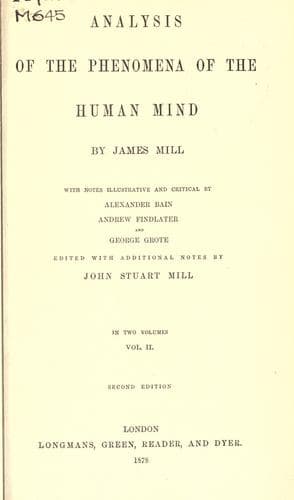
Analysis of the Phenomena of the Human MindMill, James
PhilosophyPhilosophy
Analysis of the Phenomena of the Human Mind
Mill, James
Psychology
any means of supplying the place of one, except the employment of
pronouns and particles. Mariner makes a similar remark respecting
the Tonga language; and we may venture to affirm that there is not
such a thing as a true verb substantive in any one member of the
great Polynesian family.
"It is true that the Malayan, Javanese and Malagassy grammarians
talk of words signifying _to be_; but an attentive comparison of the
elements which they profess to give as such, shows clearly that they
are no verbs at all, but simply pronouns or indeclinable particles,
commonly indicating the time, place or manner of the specified
action or relation. It is not therefore easy to conceive how the
mind of a Philippine islander, or of any other person, can supply a
word totally unknown to it, and which there is not a particle of
evidence to show that it ever thought of."
Of the substitutes put in place of the substantive verb, by far the
most common are pronouns, and particles indicating position. Thus in
Coptic, the descendant of the ancient Egyptian, the demonstrative
_pe_, "this," after a noun singular masculine, or _te_ when the noun
is feminine, is equivalent to _is_; and _ne_, "these," after a
plural, to _are_. In the ancient hieroglyphic monuments the function
of the substantive verb is performed by the same means. Even in the
Semitic languages, which have substantive verbs, pronouns are
habitually used instead of them; so that _I I_, or _I he_, stands
for _I am_, and _we we_ or _we they_, for _we are_. "Thou art my
King" (Ps. 44, 5) is in the Hebrew "Thou _he_ my King;" "We are the
servants of the God of heaven" (Ezra 5, 11) is in Chaldee "We _they_
servants of the God of heaven;" "I am the light of the world," is in
Arabic "I _he_ the light of the world."
Although such modes of expression are foreign to the Indo-European
languages, even they furnish abundant evidence of the predicative
power of pronouns and particles. If any word required to have
inherent in it the peculiar affirmative power attributed to verbs,
it is the word _yes_. Accordingly Tooke derives it from the French
imperative _a-yez_: forgetting, or not knowing, that the Anglo-Saxon
_gese_ or _yea_ (cognate with the Sanscrit pronoun _ya_) was in
existence long before the French _ayez_. The fact is that Eng.
_yes_, Ger. _ja_, and the corresponding words in the other European
languages are oblique cases of demonstrative pronouns, and mean
simply "in this (manner)," or "thus." The Italian _si_ (yes) is from
Lat. _sic_, (thus); the Provençal _oc_ is from Lat. _hoc_; and the
modern Fr. _oui_ was originally a combination of _hoc illo_, and
passed through the stages of _ocil_ and _oil_ into its present form.
Public-domain text, read in full here on John Shaqi.
Reviews
Reviews
No reviews yet
Be the first to share your thoughts on this work.
Elsewhere in the archive
Join the Discussion
Join the discussion
Sign in to leave a comment or review.
Sign InorCreate an account