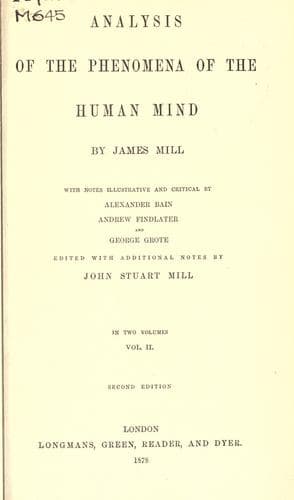
Analysis of the Phenomena of the Human MindMill, James
PhilosophyPhilosophy
Analysis of the Phenomena of the Human Mind
Mill, James
Psychology
The consideration of these and a multitude of similar phenomena
suggests, that the Sanscrit _as-mi_, Gr. _ei-mi_, Lat. _s-um_ (for
_es-um_), Eng. _a-m_, may have had for its root the demonstrative
pronoun _sa_, and meant primarily "that (or there) as to me." Be
that as it may, all philologists are agreed that the verbs now used
to express _being_ in the abstract, expressed originally something
physical and palpable. Thus Ital. _stato_, Fr. _été_, _been_, are
from the Lat. _statum_, the participle of _sto_, "to stand;" and
_exist_ itself meant "to stand out or be prominent." Eng. _be_, Lat.
_fu-_ is identical with Gr. _phy-_ "to grow;" and, according to Max
Müller, as the root of _as-mi_ meant "breath" or "breathing." It may
then be safely affirmed that no word had for its primary function to
express mere existence; it seems enough for the purpose of
predication that existence be implied.
With regard to ordinary verbs, the analytic processes of comparative
grammar show no traces of a substantive verb entering into their
structure. It is now an accepted doctrine of philology that, as a
rule, the root of a verb is of the nature of an abstract noun; and
that it became a verb simply by the addition of a pronominal
affix--as in the Greek [Greek: di/-dô-mi, di/-dô-s, di/-dô-si], in
which the terminations were originally [Greek: -mi, -si, -ti]. The
habits of thought arising out of the present analytic state of the
Indo-European languages naturally lead us to conceive these
pronominal affixes as nominatives. But _gift I_ does not seem a very
natural way of getting at the meaning "I give;" and therefore Mr.
Garnett maintains that the affixes were originally in an oblique
case--the genitive or the instrumental--so that the literal meaning
was "gift of me," or "giving by me." That this is the nature of the
verb in the agglutinate languages--by far the most numerous
class--it seems hardly possible to dispute; for in these the affixes
remain rigidly distinct and little disguised. Thus, according to
Garnett, the Wotiak, in order to express "my son," "thy son," &c.,
joins oblique cases of the personal pronouns to the noun _pi_ in the
following way:--
pi-[)i] .... son of me
pi-ed . . . son of thee
pi-ez . . . son of him
pi-mi . . . son of us
pi-dy . . . son of you
pi-zy . . . son of them
In an exactly similar way the preterite of the verb to speak stands
thus--
bera-i . . . speech of me == I spoke
bera-d . . . speech of thee
bera-z . . . speech of him
bera-my . . speech of us
bera-dy . . speech of you
bera-zy . . speech of them
In the Fiji language _loma_ means "heart" or "will;" and _loma-qu_
(heart of me) may, according to the connection, signify either "my
heart or will," or "I will."
Public-domain text, read in full here on John Shaqi.
Reviews
Reviews
No reviews yet
Be the first to share your thoughts on this work.
Elsewhere in the archive
Join the Discussion
Join the discussion
Sign in to leave a comment or review.
Sign InorCreate an account