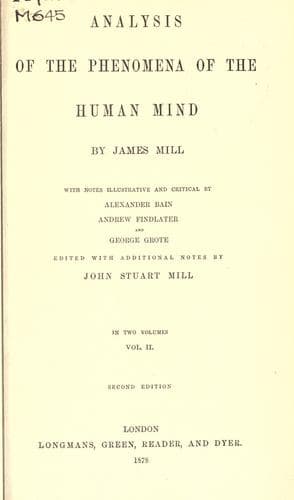
Analysis of the Phenomena of the Human MindMill, James
PhilosophyPhilosophy
Analysis of the Phenomena of the Human Mind
Mill, James
Psychology
Here, however, a peculiarity is to be noted. When there is a
possessor, there is something possessed. {203} The preposition,
therefore, which marks the relation between the possessor and the
possessed, stands ambiguously between the active and the passive
power. It, therefore, partakes more of the active or the passive
signification, according to the position of the words which it is
employed to connect. In the instances previously given, we have seen
that it had clearly an active signification. In the following it has
clearly a passive. "The book of John;" the book _of_, hav(ed) John.
"The Creator of the world;" Creator hav(ed). "The wealth of
Croesus;" wealth hav(ed).
Of is employed in a partitive sense, when one of the words denotes a
part of the other; as "half of the army;" "many of the people;"
"much of the loss." In this case the idea of possession is
sufficiently obvious to support the analogy. The parts are
possessed, had, by the whole. "Part of the debt," part hav(ed) the
debt.
It is easy to see how the preposition with a substantive, serves the
purpose of a new adjective. Thus, in the expression, "a man with one
eye," the words, "with one eye," might have been supplied by an
adjective, having the same meaning or marking power; and the French
language actually has such an adjective, in the mark _borgne_. We
say, a man with red hair, and we have the adjective, red-haired; a
man of wealth, and we have the adjective, wealthy; a man of
strength, and we have the adjective, strong; cases which distinctly
exemplify our observation.
2. We come now to shew in what manner, and with what advantage,
prepositions are employed to connect Substantives with Adjectives.
The following {204} classes of adjectives will furnish sufficient
illustration of this part of the subject: 1, Adjectives of place or
position; *2, Adjectives of time or succession; 3, Adjectives
signifying profit or disprofit; 4, Adjectives of plenty or want; 5,
Adjectives signifying an affection or state of the mind.
Public-domain text, read in full here on John Shaqi.
Reviews
Reviews
No reviews yet
Be the first to share your thoughts on this work.
Elsewhere in the archive
Join the Discussion
Join the discussion
Sign in to leave a comment or review.
Sign InorCreate an account