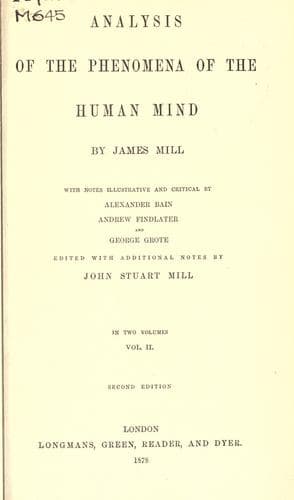
Analysis of the Phenomena of the Human MindMill, James
PhilosophyPhilosophy
Analysis of the Phenomena of the Human Mind
Mill, James
Psychology
Adjectives of position, such as near, distant, high, low, have the
ordinary power of adjectives, as marks upon marks; and an additional
power, which will best be explained by examples. When we say "a
distant house," "a neighbouring town;" the words "distant," and
"neighbouring," are not only marks upon "house," and "town," but
refer to something else: "a _distant_ house," is a house distant
from _something_; "a _neighbouring_ town," is a town neighbouring
_something_: it may mean "a house distant from my house," "a town
neighbouring my house:" in these cases, we should say that the
adjective has both a notation, and a connotation. The adjective
_distant_, for example, notes _house_, and connotes _my house_;
neighbouring, notes _town_, connotes _my house_. It is next,
however, to be observed, that the connotation, in such cases, would
be vague without a mark to determine it. The expression would be
very imperfect, if, after the word high, we were merely to put the
word "hill;" and say, "the house is high the hill;" or, "the house
is distant the post-town." Prepositions supply this defect. We say,
"the house is high _on_ the hill;" "the house is distant _from_ the
post-town." In the case of some adjectives, their juxta-position
makes the reference sufficiently precise; and in that case, the
preposition may be dispensed with; as, near the town, near the road,
&c.
{205} It is observable, that the adjectives of position are not
numerous. Some very general ones are used; and the sub-species are
formed out of them by the aid of prepositions. Thus we have the word
placed, which includes all positions; and this, joined with a
substantive and a preposition, marks positions of all kinds: thus we
can say, placed on the right hand, placed on the left hand, placed
behind the house, placed before the house, placed above it, placed
below it, placed in it, and so on.
It is not my intention to inquire into the precise meaning of each
of the prepositions. It is sufficient to have given a sample of the
inquiry, as in the case of the prepositions which connect
substantives with substantives; and to have shewn the mode of their
signification, as a kind of abstract terms, either active or
passive.
The varieties of time or succession are not many, and the words to
denote them, proportionally few. Previous, simultaneous, posterior,
are the principal adjectives; and the terms to which these words of
reference point, are marked by prepositions: thus we say, previous
to, simultaneous to, and also with; "with," as we have seen,
denoting junction, sameness of time.
Public-domain text, read in full here on John Shaqi.
Reviews
Reviews
No reviews yet
Be the first to share your thoughts on this work.
Elsewhere in the archive
Join the Discussion
Join the discussion
Sign in to leave a comment or review.
Sign InorCreate an account