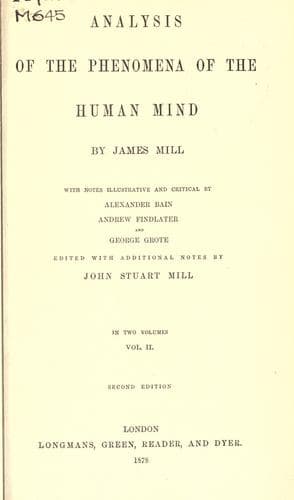
Analysis of the Phenomena of the Human MindMill, James
PhilosophyPhilosophy
Analysis of the Phenomena of the Human Mind
Mill, James
Psychology
We have compound names for many actions. Thus we may say, "he hurt
John," or "he did hurt to John," "he gave a lecture to John," or,
"he lectured John." The reason why a preposition is required before
the patient, in the case of the compound name of the action, and not
of the single name, is, that the word which stands with respect to
the verb in the {209} immediate relation of the recipient or patient
of the action, is not the man, but the thing done. Thus, in the
phrase, "he did hurt to John," it is not John which is done, but
hurt: in the phrase, "he gave a lecture to John," it is not John who
is given, but a lecture. There are here as it were, two patients,
lecture, the primary, John, the secondary; juxta-position marks the
connexion of the primary; but a preposition is necessary, to mark
that of the secondary.
The following phrases seem to admit of a similar explanation. "He
reminded him of his promise;" "he accused him of perjury;" "he
deprived him of his wife:" the secondary patients being "promise,"
"perjury," "wife." He reminded him of his promise (hav(ed) his
promise); the promise being the thing had or conceived in the
reminding: accused him of perjury; perjury being the thing had in
the accusation, the matter of the accusation: deprived him of his
wife; his wife being the matter of the deprivation; the thing
hav(ed) in it.[61]
[Findlater's footnote 61: The ingenious speculations of Mr. Tooke
did great service to the cause of philology in England, by awakening
a very general interest in the subject. But his knowledge of the
cognate languages was far too circumscribed to warrant his sweeping
inductions. In his day, in fact, the accesses had not yet been
opened up to this new mine, nor the right veins struck that have
since yielded such rich results. Accordingly nearly all Tooke's
derivations are now discredited, and among others his account of
prepositions. One or two English prepositions, of comparatively
recent formation, seem to be formed from nouns; as _among_ Ang. Sax.
_gemang_ or _ongemang_, _gemang_ meaning "mixture;" and _against_,
Ang. Sax. _on-gegen_ in which _gegen_, from its use in cognate
dialects, appears to be {210} a noun, though its primary meaning is
not very clear. These however still involve a preposition which has
to be accounted for. _Between_, again, is _by twain_, "near two;"
and _except_, _save_, _during_ were originally participles in the
case absolute; "except this" was originally "this excepted," Lat.
hoc excepto. But the simple prepositions _in_, _of_, _by_ belong to
the radical elements of language, and are more independent of nouns
and verbs than nouns and verbs are of them. Comparative philology,
which did not exist in Tooke's days, has shewn, that, besides
predicative roots, as they are called--that is syllables expressive
of some action or property, such as "to go," "to eat," "to be
bright," "to speak," &c., which form the bases of nouns, adjectives,
Public-domain text, read in full here on John Shaqi.
Reviews
Reviews
No reviews yet
Be the first to share your thoughts on this work.
Elsewhere in the archive
Join the Discussion
Join the discussion
Sign in to leave a comment or review.
Sign InorCreate an account