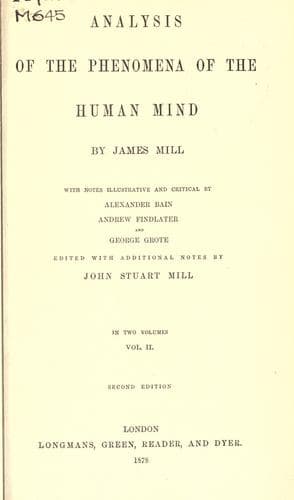
Analysis of the Phenomena of the Human MindMill, James
PhilosophyPhilosophy
Analysis of the Phenomena of the Human Mind
Mill, James
Psychology
With respect to motions, we have occasion to mark, not only the
points of their commencement and termination, but also their
direction. The direction of a motion, by which we mean the position
of the moving body, at the several points of its course, can only be
marked by a reference to other bodies, whose position is known.
Thus, "He walked through the field." The direction of the walk, or
the position of the walking man, at the several moments of it, is
marked by a reference to the field whose position is known to me,
and a word which means from side to side. The expression, "It flew
in a straight line," is less full and particular in its marking, but
clear and distinct, as far as it goes, by reference to a
modification of position; namely, a line, with which I am perfectly
familiar.
In using verbs of action and passion, that is, words which mark a
certain cluster of ideas, we have occasion to modify such clusters,
by adding to, or taking from them, not only ideas of Position, as
above, but various other ideas; of which the idea of {208} the
Cause, or End, of the action, the idea of the Instrument with which
it was performed, and the idea of the Manner of the performance, are
among the principal. "John worked;" to this, a mark of a certain
cluster of ideas, I want to make an addition, that of the Cause or
End of his working. That End is, Bread. To mark this as the cause of
his working, it is not enough to set down the name bread; I need a
mark to fix its connexion with the working, and the kind of its
connexion. I say, "John worked for (cause) bread." "John was robbed
for (cause of the robbery) his money." The ideas of manner and
instrument are commonly annexed by one preposition; "John worked
with (joining) diligence," the manner; "John worked with a spade,"
the same idea, as "John with (joined) a spade worked;" spade, the
instrument. "John worked by the job, worked by the day;" manner:
"John worked by machinery," the instrument. "He was killed with
barbarity, with a cudgel."
We say, done with hurry, or in a hurry, done in haste. "In," which
seems to mark a modification of position, is here applied to that
which does not admit of position. Hurry and haste seem in such
expressions to be personified; to be things which surround an
action, and in the midst of which it is done.
Public-domain text, read in full here on John Shaqi.
Reviews
Reviews
No reviews yet
Be the first to share your thoughts on this work.
Elsewhere in the archive
Join the Discussion
Join the discussion
Sign in to leave a comment or review.
Sign InorCreate an account