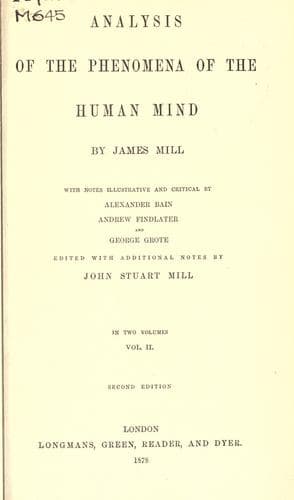
Analysis of the Phenomena of the Human MindMill, James
PhilosophyPhilosophy
Analysis of the Phenomena of the Human Mind
Mill, James
Psychology
Consciousness is the widest word in our vocabulary. By common
consent it embraces everything that "mind" embraces; while one mode
of extricating the great problem of Perception from
self-contradictions, makes it mean more than mind strictly means. We
speak of the _object-consciousness_ as our attitude in being
cognisant of the extended universe; while our attitude under
feeling, and thought, we call _subject-consciousness_, or mind.
The object-consciousness follows one set of laws, the laws of matter
and space, as propounded in Mathematics, Natural Philosophy, and so
on. The subject-consciousness follows a different set of laws, such
as the laws of pleasure and pain, and the association of ideas,
treated of in Psychology. We are conscious objectively, in counting
the stars, we are conscious subjectively, in feeling oppressed by
their number.
The subject-consciousness comprises all our feelings and thoughts;
it enters into volition; and it makes a part of sensation, in which
both attitudes are conjoined. This {227} consciousness may be faint
and limited, or it may be intense and variegated. We may be in a
state of pleasure with little or nothing of thought accompanying; we
are still properly said to be conscious or under consciousness. But
we may add to the mere fact of pleasure, the _cognition of the
state_, as a state of pleasure, and as a state belonging to us at
the time. This is not the same thing as before: it is something new
superposed upon the previous consciousness. When we take note of the
fact that we are pleased, we proceed beyond the bare experience of
the present pleasure, to an intellectual act of comparison,
assimilation, or classification with past pleasures; we probably
introduce the machinery of language to express ourselves as pleased;
all this is so much _extra_ consciousness. These knowing operations
are not involved in mere feeling; we may feel without them. Indeed,
if the cognitive powers are brought into very active exercise upon
our feelings, as in the self-dissection of the Psychologist, the
feelings themselves are apt to subside.
It is thus correct to draw a line between feeling, and knowing that
we feel; although there is great delicacy in the operation. It may
be said, in one sense, that we cannot feel without knowing that we
feel, but the assertion is verging on error; for feeling may be
accompanied with a minimum of cognitive energy, or as good as none
at all; or it may be accompanied with an express application of our
knowing powers, which is purely optional on our part, and even
hostile to the full development of the feeling as feeling, as
pleasure or pain.
Public-domain text, read in full here on John Shaqi.
Reviews
Reviews
No reviews yet
Be the first to share your thoughts on this work.
Elsewhere in the archive
Join the Discussion
Join the discussion
Sign in to leave a comment or review.
Sign InorCreate an account