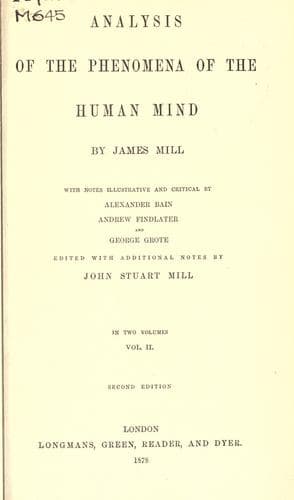
Analysis of the Phenomena of the Human MindMill, James
PhilosophyPhilosophy
Analysis of the Phenomena of the Human Mind
Mill, James
Psychology
Reid wanted a name to express the act of scrutinizing or examining
the mind, and to correspond with such names as Perception,
Observation, for the study of the extended or object universe. He
used Consciousness for this purpose; a word that had been probably
more applied to our cognitive energies than to our experience of
mere feeling in its simplest manifestation. It is not often that
"consciousness" is employed as the popular designation of states of
feeling as such, states of marked enjoyment or suffering. On the
other hand, the word is frequently made use of to designate the act
of cognizing or {228} thinking of our states of feeling; for which,
however, self-consciousness is undoubtedly the more proper
appellative.
Hamilton terms "consciousness" a "condition" of our feelings and
mental operations; more correctly it is the operations themselves;
the consciousness is not the condition of the feeling, but the
feeling itself. More material is the opinion, held by Hamilton in
common with most of the German philosophers, that the foundation of
all consciousness is knowing; that we feel, only as we know that we
feel. He says, "It is evident that every mental phenomenon is either
an act of knowledge, or only possible through an act of knowledge:
for _consciousness is a knowledge--a phenomenon of cognition_."
("Metaphysics," Lect xi.) Now although we may not be able to rebut
this singular assertion by pointing to a state of feeling such as to
entirely exclude knowledge, we may ask, do the two properties, said
to be thus implicated, rise and fall in steady concomitance; the
more the knowledge, the greater the feeling? The answer must be
negative. A favourite doctrine of Hamilton, containing a certain
amount of truth, affirms an inverse ratio between knowing and
feeling; which it is difficult to reconcile with the present
doctrine. A new distinction must be laid down between the kind of
knowing that constitutes "feeling," and the kind of knowing that
constitutes "knowing" in the strict sense of knowledge. We may
concede to Hamilton that feeling must always be within reach of a
cognitive exertion, but it cannot be conceded that an actual
cognitive exertion is essential to the manifestation of the feeling.
Such exertion unless kept within narrow limits of intensity cools
down instead of promoting the emotional state.
Public-domain text, read in full here on John Shaqi.
Reviews
Reviews
No reviews yet
Be the first to share your thoughts on this work.
Elsewhere in the archive
Join the Discussion
Join the discussion
Sign in to leave a comment or review.
Sign InorCreate an account