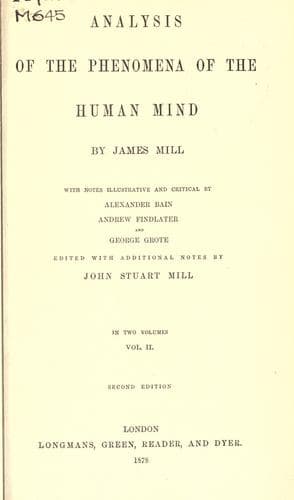
Analysis of the Phenomena of the Human MindMill, James
PhilosophyPhilosophy
Analysis of the Phenomena of the Human Mind
Mill, James
Psychology
The facts of the case appear to be best represented, by allowing the
state of Feeling to stand on its own independent foundation as a
mode of the subject-consciousness, or of mind. There may, and almost
always does, go along with it a certain degree of cognitive effort.
We can scarcely be under feeling, without performing some function
of an intellectual kind; the divisions of the mental energies do not
imply that they can exist in absolute separation. The act of
discriminating the {229} degree of feeling,--of pronouncing a
pleasure to be greater than, or equal to, some other pleasure,--is
properly an intellectual, or cognitive exercise; but this
discrimination does not make the feeling. So a feeling cannot exist
without impressing the memory in some degree, which is an
intellectual function; one may truly affirm that we do not feel
unless, immediately afterwards, we remember that we felt. It is an
incident or concomitant of feeling to leave an impression behind,
but this does not characterize or define the state of feeling. Being
an accompaniment or concomitant of an emotional excitement, we may
point to memory as a proof of its existence and a criterion of its
degree, but we should confuse all the boundaries of mental
phenomena, if we treated memory or retentiveness otherwise than as
an intellectual property, a property whose sphere is intellect and
not feeling.--_B._]
[Editor's footnote 75: Those psychologists who think that being
conscious of a feeling is something different from merely having the
feeling, generally give the name Consciousness to the mental act by
which we refer the feeling to ourself; or, in other words, regard it
in its relation to the series of many feelings, which constitutes
our sentient life. Many philosophers have thought that this
reference is necessarily involved in the fact of sensation: we
cannot, they think, have a feeling, without having the knowledge
awakened in us at the same moment, of a Self who feels it. But of
this as a primordial fact of our nature, it is impossible to have
direct evidence; and a supposition may be made which renders its
truth at least questionable. Suppose a being, gifted with sensation
but devoid of memory; whose sensations follow one after another, but
leave no trace of their existence when they cease. Could this being
have any knowledge or notion of a Self? Would he ever say to
himself, _I_ feel; this sensation is _mine_? I think not. The notion
of a Self is, I apprehend, a consequence of Memory. There is no
meaning in the word Ego or I, unless the I of to-day is also the I
of yesterday; a permanent element which abides through a succession
of feelings, and connects the feeling of each moment with the
remembrance of previous feelings. We have, no {230} doubt, a
considerable difficulty in believing that a sentient being can exist
without the consciousness of Itself. But this difficulty arises from
the irresistible association which we, who possess Memory, form in
Public-domain text, read in full here on John Shaqi.
Reviews
Reviews
No reviews yet
Be the first to share your thoughts on this work.
Elsewhere in the archive
Join the Discussion
Join the discussion
Sign in to leave a comment or review.
Sign InorCreate an account