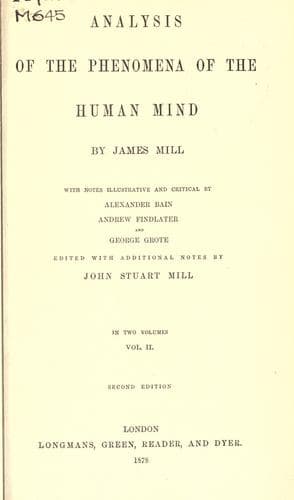
Analysis of the Phenomena of the Human MindMill, James
PhilosophyPhilosophy
Analysis of the Phenomena of the Human Mind
Mill, James
Psychology
In some cases we are even said to be, by an act of attention, made
conscious of a feeling of which we should otherwise have {231} been
unconscious: and there is much difference of opinion as to what it
is which really occurs in this case. The point has received some
consideration in a former Note, but there may be advantage in again
recalling it to remembrance. It frequently happens (examples of it
are abundant in the Analysis) that certain of our sensations, or
certain parts of the series of our thoughts, not being sufficiently
pleasurable or painful to compel attention, and there being no
motive for attending to them voluntarily, pass off without having
been attended to; and, not having received that artificial
intensification, they are too slight and too fugitive to be
remembered. We often have evidence that these sensations or ideas
have been in the mind; because, during their short passage, they
have called up other ideas by association. A good example is the
case of reading from a book, when we must have perceived and
recognized the visible letters and syllables, yet we retain a
remembrance only of the sense which they conveyed. In such cases
many psychologists think that the impressions have passed through
the mind without our being conscious of them. But to have feelings
unconsciously, to have had them without being aware, is something
like a contradiction. All we really know is that we do not remember
having had them; whence we reasonably conclude that if we had them,
we did not attend to them; and this inattention to our feelings is
what seems to be here meant by being unconscious of them. Either we
had the sensations or other feelings without attending to them, and
therefore immediately forgot them, or we never, in reality, had
them. This last has been the opinion of some of the profoundest
psychologists. Even in cases in which it is certain that we once had
these feelings, and had them with a lively consciousness (as of the
letters and syllables when we were only learning to read) yet when
through numberless repetitions the process has become so rapid that
we no longer remember having those visual sensations, these
philosophers think that they are elided,--that we cease to have them
at all. The usual impressions are made on our organs by the written
characters, and are transmitted to the brain, but these organic
states, {232} they think, pass away without having had time to
excite the sensations corresponding to them, the chain of
association being kept up by the organic states without need of the
sensations. This was apparently the opinion of Hartley; and is
distinctly that of Mr. Herbert Spencer. The conflicting suppositions
are both consistent with the known facts of our mental nature. Which
of them is the true, our present knowledge does not, I think, enable
us to decide.
Public-domain text, read in full here on John Shaqi.
Reviews
Reviews
No reviews yet
Be the first to share your thoughts on this work.
Elsewhere in the archive
Join the Discussion
Join the discussion
Sign in to leave a comment or review.
Sign InorCreate an account