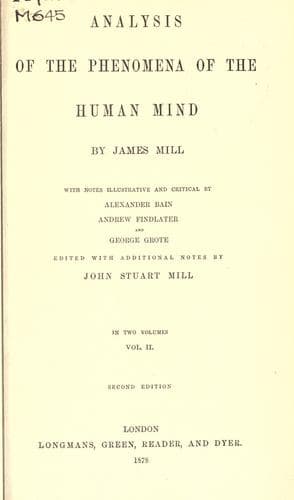
Analysis of the Phenomena of the Human MindMill, James
PhilosophyPhilosophy
Analysis of the Phenomena of the Human Mind
Mill, James
Psychology
The author of the Analysis often insists on the important doctrine
that we have many feelings, both of the physical and of the mental
class, which, either because they are permanent and unchangeable, or
for the contrary reason, that they are extremely fugitive and
evanescent, and are at the same time uninteresting to us except for
the mental processes they originate, we form the habit of not
attending to; and this habit, after a time, grows into an
incapacity; we become unable to attend to them, even if we wish. In
such cases we are usually not aware that we have had the feelings;
yet the author seems to be of opinion that we really have them. He
says, for example, in the section on Muscular Sensations (ch. i.
sect. vii.) "We know that the air is continually pressing upon our
bodies. But the sensation being continual, without any call to
attend to it, we lose from habit, the power of doing so. The
sensation is as if it did not exist." Is it not the most reasonable
supposition that the sensation does not exist; that the necessary
condition of sensation is change; that an unchanging sensation,
instead of becoming latent, dwindles in intensity, until it dies
away, and ceases to be a sensation? Mr. Bain expresses this mental
law by saying, that a necessary condition of Consciousness is
change; that we are conscious only of changes of state. I apprehend
that change is necessary to consciousness of feeling, only because
it is necessary to feeling: when there is no change, there is, not a
permanent feeling of which we are unconscious, but no feeling at
all.
In the concluding chapter of Mr. Bain's great work, there is an
enumeration of the various senses in which the word Consciousness is
used. He finds them no fewer than thirteen.--_Ed._]
{233} CHAPTER VI.
CONCEPTION.
"The generalizations of language are already made for us, before we
have ourselves begun to generalize; and our mind receives the
abstract phrases without any definite analysis, almost as readily as
it receives and adopts the simple names of persons and things. The
separate co-existing phenomena, and the separate sequences of a long
succession of words, which it has been found convenient to
comprehend in a single word, are hence, from the constant use of
that single word, regarded by the mind almost in the same manner, as
if they were only one phenomenon, or one event."--_Inquiry into the
Relation of Cause and Effect_. _By Thomas Brown, M.D._ Note M, p.
567.
THE philosophers, who erected CONSCIOUSNESS into what they called a
Power of the mind, have bestowed the same rank upon CONCEPTION.
Public-domain text, read in full here on John Shaqi.
Reviews
Reviews
No reviews yet
Be the first to share your thoughts on this work.
Elsewhere in the archive
Join the Discussion
Join the discussion
Sign in to leave a comment or review.
Sign InorCreate an account