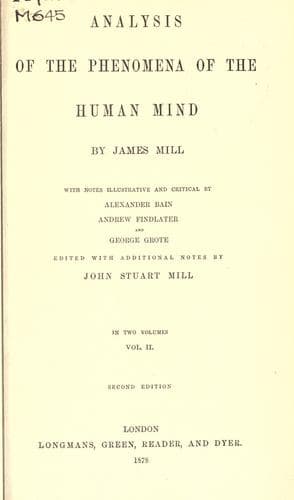
Analysis of the Phenomena of the Human MindMill, James
PhilosophyPhilosophy
Analysis of the Phenomena of the Human Mind
Mill, James
Psychology
We may notice here, however, one of those curious illusions, which
the intimate associations of ideas with words, so often, and
sometimes so inconveniently, occasion. The term "I conceive," has
the form of an active verb; and with _the form of an active verb_
THE IDEA OF ACTION is so frequently conjoined, that we are rarely
able to separate them. By this means, the idea of activeness is
often mixed up with other ideas, when it is wholly misplaced and
illusive. I use the same form of expression when I say, I dream; as
when I say, I study, I argue, I imagine. In these cases the idea of
what I call activity is properly included: in the expression I
dream, it is not properly included; though the active form of the
verb so invariably calls up a certain idea of activity, and so
strongly tends to mix it with the other ideas, that in using the
term, "I dream," we seem to consider ourselves as, somehow, agents.
Even in using the term, "I die," we cannot escape the illusion;
though the ideas are so highly incongruous. It would be obviously
absurd to affirm that we are less active when we say we have an
idea, than when we say we have a conception, yet there is constantly
a feeling, when we use the phrase "I conceive," as if we were in
some manner active; and no such feeling, when we use the phrase
"I have an idea." The terms, therefore, the concrete "conceive,"
and its abstract "conception," are somewhat inconvenient, and
misguiding, as they infuse into the complex ideas to which they are
applied, an ingredient which does not belong to them.
The relation which the words, CONSCIOUSNESS, and {236} CONCEPTION,
bear to one another, is now, therefore, apparent. Consciousness is
the more _generical_ of the two names. Conception is the name of a
class _included under_ the name Consciousness. Consciousness applies
to sensations, and to ideas, whether simple or complex; to all the
feelings, whatsoever they may be, of our sentient nature. Conception
applies only to ideas; and to ideas, only in a state of combination.
It is a generical name including the several classes of complex
ideas.[76]
Public-domain text, read in full here on John Shaqi.
Reviews
Reviews
No reviews yet
Be the first to share your thoughts on this work.
Elsewhere in the archive
Join the Discussion
Join the discussion
Sign in to leave a comment or review.
Sign InorCreate an account