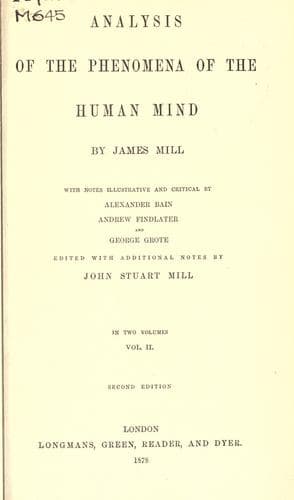
Analysis of the Phenomena of the Human MindMill, James
PhilosophyPhilosophy
Analysis of the Phenomena of the Human Mind
Mill, James
Psychology
When we have a Sensation, we are not said, in the ordinary use of
the word, to Conceive. If burned with the candle, I do not say, "I
conceive the pain;" I do not say, if I smelt putrescence, that "I
conceive the stench." It even seems to be not without a sort of
impropriety, if the term is ever applied to mark a simple Idea. We
should not, in ordinary language, say, "I conceive red," "I conceive
green." We say, however, "I conceive a horse," "I conceive a tree,";
I conceive a ship;" we say also, "I conceive an {234} argument," "I
conceive a plan." In these examples, which may be taken as a
sufficient specimen of the manner in which the term Conception is
used, we see that it is applied exclusively to cases of the
secondary feelings; to the Idea, not the Sensation; and to the case
of compound, not of single ideas. With this use, the etymology of
the word very accurately corresponds: I conceive, that is, _I take
together_, a horse; that is, the several ideas, combined under the
name horse, and constituting a compound idea. The term conception,
we have seen, applies not only to those combinations of ideas, which
we call the ideas of external objects, but to those combinations
which the mind makes for its own purposes.
It thus appears, that the word CONCEPTION is a _generical_ name,
like CONSCIOUSNESS; but less comprehensive. We call ourselves
conscious, when we have any sensation, or any idea. We say that we
conceive, only when we have some complex idea. It remains to be
inquired, whether by saying we conceive, or have a conception, we
mean any thing whatsoever beside having an idea.
If I say, I have the idea of a horse, I can explain distinctly what
I mean. I have the ideas of the sensations of sight, of touch, of
hearing, of smelling, with which the body and actions of a horse
have impressed me; these ideas, all combined, and so closely, that
their existence appears simultaneous, and one. This is my IDEA of a
horse. If I say, I have a CONCEPTION of a horse, and am asked to
explain what I mean, I give the same account exactly, and I can give
no other. My CONCEPTION of the horse, is merely my taking together,
in one, the simple ideas of the {235} sensations which constitute my
knowledge of the horse; and my IDEA of the horse is the same thing.
Public-domain text, read in full here on John Shaqi.
Reviews
Reviews
No reviews yet
Be the first to share your thoughts on this work.
Elsewhere in the archive
Join the Discussion
Join the discussion
Sign in to leave a comment or review.
Sign InorCreate an account