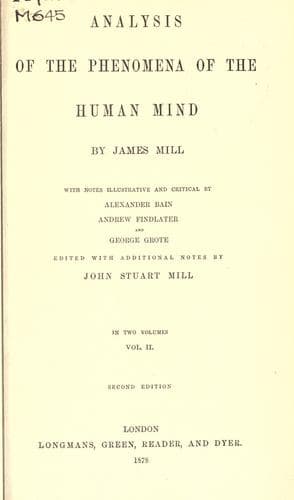
Analysis of the Phenomena of the Human MindMill, James
PhilosophyPhilosophy
Analysis of the Phenomena of the Human Mind
Mill, James
Psychology
The trains of one class differ from those of another, the trains of
the merchant, for example, from those of the lawyer, not in this,
that the ideas follow one an other by any other law, in the mind of
the one, and the mind of the other; they follow by the same laws
exactly; and are equally composed of ideas, mixed indeed with
sensations, in the minds of both. The difference consists in this,
that the ideas which flow in their minds, and compose their trains,
are ideas of different things. The ideas of the lawyer are ideas of
the legal provisions, forms, and distinctions, and of the actions,
bodily, and mental, about which he is conversant. The ideas of the
merchant are equally ideas of the objects and operations, about
which he is concerned, and the ends toward which his actions are
directed; but the objects and operations themselves, are remarkably
different. The trains of poets, also, do not differ from the trains
of other men, but perfectly agree with them, in this, that they are
composed of ideas, and that those ideas succeed one another, {242}
according to the same laws, in their, and in other minds. They are
ideas, however, of very different things. The ideas of the poet are
ideas of all that is most lovely and striking in the visible
appearances of nature, and of all that is most interesting in the
actions and affections of human beings. It thus, however, appears
most manifestly, that the trains of poets differ from those of other
men in no other way, than those of other men differ from one
another; that they differ from them by this only, that the ideas of
which they are composed, are ideas of different things. There is
also nothing surprising in this, that, being trains of pleasurable
ideas, they should have attracted a peculiar degree of attention;
and in an early age, when poetry was the only literature, should
have been thought worthy of a more particular naming, than the
trains of any other class. These reasons seem to account for a sort
of appropriation of the name Imagination, to the trains of the poet.
An additional reason may be seen in another circumstance, which also
affords an interesting illustration of a law of association already
propounded; namely, the obscuration of the antecedent part of a
train, which leads to a subsequent, more interesting than itself. In
the case of the lawyer, the train leads to a decision favourable to
the side which he advocates. The train has nothing pleasurable in
itself. The pleasure is all derived from the end. The same is the
case with the merchant. His trains are directed to a particular end.
And it is the end alone, which gives a value to the train. The end
of the metaphysical, and the end of the mathematical inquirer, is
the discovery of truth: {243} their trains are directed to that
object; and are, or are not, a source of pleasure, as that end is or
is not attained. But the case is perfectly different with the poet.
His train is its own end. It is all delightful, or the purpose is
Public-domain text, read in full here on John Shaqi.
Reviews
Reviews
No reviews yet
Be the first to share your thoughts on this work.
Elsewhere in the archive
Join the Discussion
Join the discussion
Sign in to leave a comment or review.
Sign InorCreate an account