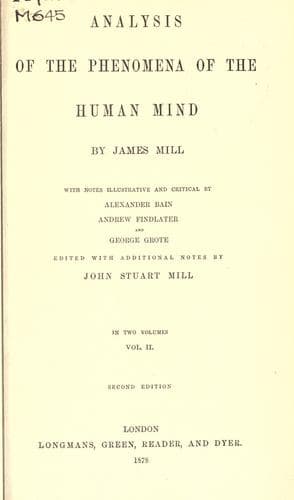
Analysis of the Phenomena of the Human MindMill, James
PhilosophyPhilosophy
Analysis of the Phenomena of the Human Mind
Mill, James
Psychology
frustrate. From the established laws of association, this
consequence unavoidably followed; that, in the case of the trains of
those other classes, the interest of which was concentrated in the
end, attention was withdrawn from the train by being fixed upon the
end; that in the case of the poet, on the other hand, the train
itself being the only object, and that pleasurable, the attention
was wholly fixed upon the train; that hence the train of the poet
was provided with a name; that in the cases of the trains of other
men, where the end only was interesting, it was thought enough that
the end itself should be named, the train was neglected.
In conformity with this observation, we find, that wherever there is
a train which leads to nothing beyond itself, and has any pretension
to the character of pleasurable (the various kinds of reverie, for
example), it is allowed the name of Imagination. Thus we say that
Rousseau indulged his imagination, when, as he himself describes it,
lying on his back, in his boat, on the little lake of Bienne, he
delivered himself up for hours to trains, of which, he says, the
pleasure surpassed every other enjoyment.
Professor Dugald Stewart has given to the word Imagination, a
technical meaning; without, as it appears to me, any corresponding
advantage. He confines it to the cases in which the mind forms new
combinations; or, as he calls them, creations; that is, {244} to
cases in which the ideas which compose the train do not come
together in the same combinations in which sensations had ever been
received. But this is no specific difference. This happens, in every
train of any considerable length, whether directed to any end, or
not so directed. It is implied in every wish of the child to fly, or
to jump over the house; in a large proportion of all his playful
expressions, as puss in boots, a hog in armour, a monkey preaching,
and so on. It is manifested in perfection in every dream. It is well
known that, for the discovery of truths in philosophy, there is a
demand for new trains of thought, multitudes of which pass in review
before the mind, are contemplated, and rejected, before the happy
combination is attained, in which the discovery is involved. If
imagination consists in bringing trains before the mind involving a
number of new combinations, imagination is probably more the
occupation of the philosopher than of the poet.
Public-domain text, read in full here on John Shaqi.
Reviews
Reviews
No reviews yet
Be the first to share your thoughts on this work.
Elsewhere in the archive
Join the Discussion
Join the discussion
Sign in to leave a comment or review.
Sign InorCreate an account