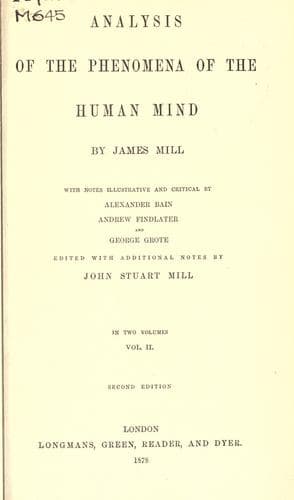
Analysis of the Phenomena of the Human MindMill, James
PhilosophyPhilosophy
Analysis of the Phenomena of the Human Mind
Mill, James
Psychology
Mr. Stewart appears not to have understood the real distinction
between the use of the words Conception, and Imagination; that the
one is the name of a single idea, the other that of a train. He also
involves, without seeming to be wholly aware of it, the idea of a
train destined to a particular end in the meaning which he bestows
on the word Imagination. Imagination is with him, not the name of a
train having merely new combinations, but of a train having new
combinations, and those destined to some end. But this is not more
the character of the trains which belong to the painter and the
poet, as his language appears to imply, than it is of the lawyer, or
the metaphysician; or, indeed, the professors of many {245} of the
vulgar arts; the tailor, for example, and the mantua-maker.[77]
[Bain's footnote 77: The foregoing analysis of the Imagination
brings to view some of the important points of distinction between
it and the other faculties; for example, the circumstance that the
trains and constructions of the Imagination are their own ends, and
not a means to farther ends, as in the constructions of science and
of the industrial arts. All creative originality is not imagination;
the steam-engine was not a product of this faculty.
The main features that distinguish the Imagination seem to be these
three:--
1. It is a faculty of the CONCRETE, like Perception and Memory, and
not of the Abstract, as the scientific faculties. When we imagine a
thing, we picture it to the mind, as far as we are able, in its full
concrete reality. Our imagination of a scene in the tropics is of
the character of an actual perception; it embraces, or should
embrace, whatever would strike the view of any one surveying the
reality.
2. Imagination rises above Perception and Memory, in being a
CONSTRUCTIVE faculty. It alters, re-arranges, puts together the
materials of perception and memory to satisfy certain demands of the
mind. In this respect, it is more than Conception, which as viewed
by the author, is also a faculty of the concrete, but introduces no
novelty of combination. Conception may involve a great constructive
effort, as when we try to picture to ourselves a poet's creation by
the help of his language; nevertheless, the term imagination loses
its characteristic force, and leaves an important meaning without a
name, if applied to this conceiving or realizing effort. The
imaginative stretch belongs to the poet or artist; the power of
conceiving is what the reader of a poem brings into exercise.
3. Imagination is swayed by some PRESENT EMOTION. This is another
way of expressing the author's view that it is an end in itself. If
we were to use the general word "feeling," we should encounter the
difficulty of separating imagination {246} from common industry,
which is all intended to gain pleasures or ward off pains.
Public-domain text, read in full here on John Shaqi.
Reviews
Reviews
No reviews yet
Be the first to share your thoughts on this work.
Elsewhere in the archive
Join the Discussion
Join the discussion
Sign in to leave a comment or review.
Sign InorCreate an account