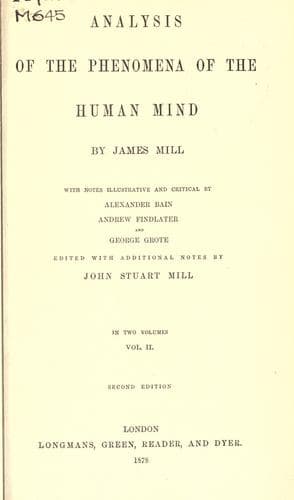
Analysis of the Phenomena of the Human MindMill, James
PhilosophyPhilosophy
Analysis of the Phenomena of the Human Mind
Mill, James
Psychology
The process in forming those classes was said to be this. The Mind
leaves out of its view this, and that, and the other thing, in which
individuals differ from one another; and retaining only those in
which they all agree, it forms them into a class. But what is {249}
this forming of a class? What does it mean? When I form a material
aggregate; when I collect a library; when I build a house; when I
even raise a heap of stones; I move the things, whatever they may
be, and place them, either regularly or irregularly, in a mass
together. But when I form a class, I perform no operation of this
sort. I touch not, nor do I in any way whatsoever act upon the
individuals which I class. The proceeding is all mental. Forming a
class of individuals, is a mode of regarding them. But what is meant
by a mode of regarding things? This is mysterious; and is as
mysteriously explained, when it is said to be the taking into view
the particulars in which individuals agree. For what is there, which
it is possible for the mind to take into view, in that in which
individuals agree? Every colour is an individual colour, every size
is an individual size, every shape is an individual shape. But
things have no individual colour in common, no individual shape in
common, no individual size in common; that is to say, they have
neither shape, colour, nor size in common. What, then, is it which
they have in common, which the mind can take into view? Those who
affirmed that it was something, could by no means tell. They
substituted words for things; using vague and mystical phrases,
which, when examined, meant nothing. Plato called it [Greek:
i)de/a], Aristotle, [Greek: ei)=dos], both, words taken from the
verb to see; intimating, something as it were seen, or viewed, as we
call it. At bottom, Aristotle's [Greek: ei)=dos], is the same with
Plato's [Greek: i)de/a], though Aristotle makes a great affair of
some very trifling differences, which he creates and sets up between
them. The Latins, translated both [Greek: i)de/a], and {250} [Greek:
ei)=dos], by the same words, and were very much at a loss for one to
answer the purpose; they used _species_, derived in like manner from
a verb to see, but which, having other meanings, was ill adapted for
a scientific word; they brought, therefore, another word in aid,
_forma_, the same with [Greek: o(/rama], derived equally from a verb
signifying to see, which suited the purpose just as imperfectly as
_species_; and as writers used both terms, according as the one or
the other appeared best to correspond with their meaning, they
thickened by this means the confusion.
Public-domain text, read in full here on John Shaqi.
Reviews
Reviews
No reviews yet
Be the first to share your thoughts on this work.
Elsewhere in the archive
Join the Discussion
Join the discussion
Sign in to leave a comment or review.
Sign InorCreate an account