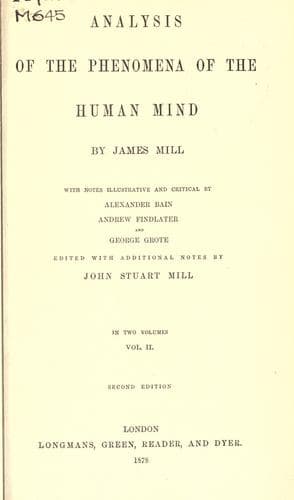
Analysis of the Phenomena of the Human MindMill, James
PhilosophyPhilosophy
Analysis of the Phenomena of the Human Mind
Mill, James
Psychology
"But if any one demand here, where this [Greek: a)ki/nêtos ou)si/a],
these immutable entities do exist? I answer, first, that as they are
considered formally, they do not properly exist in the individuals
without us, as if they were from them imprinted upon the
understanding, which some have taken to be Aristotle's opinion;
because no individual material thing is either universal or
immutable. And if these things were only lodged in the individual
sensibles, then they would be unavoidably obnoxious to the
fluctuating waves of the same reciprocating Euripus, in which all
individual material things are perpetually whirled. But because
{256} they perish not together with them, it is a certain argument
that they exist independently upon them. Neither in the next place,
do they exist somewhere else apart from the individual sensibles,
and without the mind, which is that opinion that Aristotle justly
condemns, but either unjustly or unskilfully attributes to Plato.
For if the mind looked abroad for its objects wholly without itself,
then all its knowledge would be nothing but sense and passion. For
to know a thing is nothing else but to comprehend it by some inward
ideas that are domestic to the mind, and actively exerted from it.
Wherefore these intelligible ideas or essences of things, those
forms by which we understand all things, exist no where but in the
mind itself; for it was very well determined long ago by Socrates,
in Plato's Parmenides, that these things are nothing but _noëmata_:
these species or ideas are all of them nothing but _noëmata_, or
notions that exist no where but in the soul itself.' Wherefore, to
say that there are immutable natures and essences, and *_rationes_ of
things, distinct from the individuals that exist without us, is all
one as if one should say, that there is in the universe above the
orb of matter and body, another superior orb of intellectual being,
that comprehends its own immediate objects, that is, the immutable
_rationes_ and ideas of things within itself, by which it
understands and knows all things without itself.
"And yet notwithstanding though these things exist only in the mind,
they are not therefore mere figments of the understanding: for if
the subjects of all scientifical theorems were nothing but figments,
then all truth and knowledge that is built upon them would {257} be
a mere fictitious thing; and if truth itself, and the intellectual
nature be fictitious things, then what can be real or solid in the
world? But it is evident, that though the mind thinks of these
things at pleasure, yet they are not arbitrarily framed by the mind,
but have certain, determinate, and immutable natures of their own,
which are independent upon the mind, and which are not blown away
into nothing at the pleasure of the same being that arbitrarily made
them.
Public-domain text, read in full here on John Shaqi.
Reviews
Reviews
No reviews yet
Be the first to share your thoughts on this work.
Elsewhere in the archive
Join the Discussion
Join the discussion
Sign in to leave a comment or review.
Sign InorCreate an account