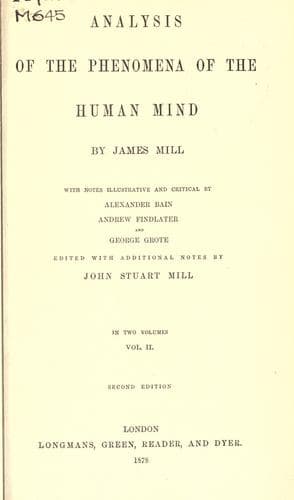
Analysis of the Phenomena of the Human MindMill, James
PhilosophyPhilosophy
Analysis of the Phenomena of the Human Mind
Mill, James
Psychology
"But we all naturally conceive that those things have not only an
eternal, but also a necessary existence, so that they could not ever
but be, such and so many as they are, and can never possibly perish
or cease to be, but are absolutely undestroyable.
"Which is a thing frequently acknowledged in the writings of both
those famous philosophers, Plato and Aristotle. The former of them
calling those things, 'things that were never made, but always are,'
and 'things that were never made, nor can be destroyed.' 'Things
ingenerable and unperishable;' _Quæ_ Plato _negat gigni sed semper
esse_ (as Tully expresseth it) _et ratione et intelligentia
contineri_. And Philo the Platonical Jew, calls the [Greek: ta\
Noêta\], which are the same things we speak of, [Greek:
a)nagkaio/tatai ou)si/ai], the most necessary essences, that is,
such things as could not but be, and cannot possibly not be. And
Aristotle himself calls the _rationes_ of things in his metaphysics,
not only [Greek: chôrista\] and [Greek: a)ki/nêta], things separate
from matter and immutable, but also [Greek: a)ï/dia], or eternal;
and in his ethics likewise, he calls geometrical truths [Greek:
a)ï/dia], eternal things, 1. 3, c. 5; 'where he makes the
geometrical truth concerning the incommensurability betwixt the
{258} diameter and the side of a square, to be an eternal thing.'
Elsewhere he tells us, that 'Science, properly so called, is not of
things corruptible and contingent,' but of things necessary,
incorruptible and eternal. Which immutable and eternal objects of
science, in the place before quoted, he described thus: 'Such a kind
of entity of things has neither motion nor generation, nor
corruption,' that is, such things as were never made, and can never
be destroyed. To which, he saith, the mind is necessarily
determined. For science or knowledge has nothing either of fiction
or of arbitrariness in it, but is 'the comprehension of that which
immutably is.'
Public-domain text, read in full here on John Shaqi.
Reviews
Reviews
No reviews yet
Be the first to share your thoughts on this work.
Elsewhere in the archive
Join the Discussion
Join the discussion
Sign in to leave a comment or review.
Sign InorCreate an account