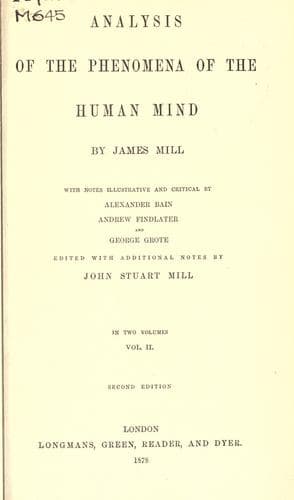
Analysis of the Phenomena of the Human MindMill, James
PhilosophyPhilosophy
Analysis of the Phenomena of the Human Mind
Mill, James
Psychology
It may still be useful to advert to the three principal cases into
which Classification may be resolved; 1, that of objects considered
as synchronical; 2, that of objects considered as successive;
3, that of feelings. The first is exemplified in the common classes
of sensible objects, as men, horses, trees, and so on; and requires
no further explanation. The second is exemplified in the classes of
events, denoted by such words, as Birth, Death, Snowing, Thundering,
Freezing, Flying, Creeping. By these words there is always denoted
one antecedent and one consequent, generally more, sometimes a long
train of them. And it is obvious that each of them is, at once, the
name of each instance individually, and of all taken generally
together. Thus, Freezing, is not the name of an individual instance
of freezing only, but of that and of all other instances of
Freezing. The same is the case with other words of a still more
general, and thence more obscure signification, as Gravitation,
Attraction, Motion, Force, &c.; which words have this additional
source of confusion, that they are {270} ambiguous, being both
abstract and concrete. When we say that there is a third case of
classification, relating to Feelings, it does not mean that the two
former do not relate to feelings: for when we say, that we classify
objects, as men, horses, &c.;--or events, as the sequences named
births, deaths, and so on;--it is obvious that our operation is
about our own feelings, and nothing else; as the objects, and their
successions, are, to us, the feelings merely which we thus
designate. But as there are feelings which we do thus designate; and
feelings which we do not; it is convenient, for the purpose of
teaching, to treat of them apart. The Feelings, of this latter kind,
which we classify, are either single feelings, or trains. Thus, Pain
is the name of a single feeling, and the name both of an individual
instance, and of indefinite instances, forming a most extensive
class. Memory is the name not of a single feeling or idea, but of a
train; and it is the name not only of a single instance, but of all
instances of such a train, that is, of a class. The same is the case
with Belief. It is the name of a train consisting of a certain
number of links; and it is the name not only of an individual
instance of such trains, but of all instances, forming an extensive
class. Imagination is another instance of the same sort of
classification. So also is Judgment, and Reasoning, and Doubting,
and we might name many more.
Public-domain text, read in full here on John Shaqi.
Reviews
Reviews
No reviews yet
Be the first to share your thoughts on this work.
Elsewhere in the archive
Join the Discussion
Join the discussion
Sign in to leave a comment or review.
Sign InorCreate an account