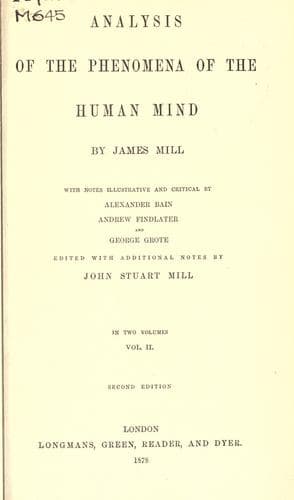
Analysis of the Phenomena of the Human MindMill, James
PhilosophyPhilosophy
Analysis of the Phenomena of the Human Mind
Mill, James
Psychology
It is easy to see, among the principles of Association, what
particular principle it is, which is mainly concerned in
Classification, and by which we are rendered capable of that mighty
operation; on which, as its basis, the whole of our intellectual
structure is reared. That principle is Resemblance. It seems to
{271} be similarity or resemblance which, when we have applied a
name to one individual, leads us to apply it to another, and
another, till the whole forms an aggregate, connected together by
the common relation of every part of the aggregate to one and the
same name. Similarity, or Resemblance, we must regard as an Idea
familiar and sufficiently understood for the illustration at present
required. It will itself be strictly analysed, at a subsequent part
of this Inquiry.
So deeply was the sagacious mind of Plato, far more philosophical
than that of any who succeeded him, during many ages, struck with
the importance of Classification, that he seems to have regarded it
as the sum of all philosophy; which he described, as being the
faculty of seeing "the ONE in the MANY, and the MANY in the ONE;" a
phrase which, when stripped from the subtleties of the sophists whom
he exposed, and from the mystical visions of his successors, of
which he never dreamed, is really a striking expression of what in
classification is the matter of fact. His error lay, in
misconceiving the ONE; which he took, not for the aggregate, but
something pervading the aggregate.[79] [80]
[Grote's footnote 79: The two chapters (VII. and VIII.) of Mr. James
Mill's Analysis are highly instructive, and exhibit all his
customary force and perspicuity. But in respect to Classification
and Abstraction, I think that the ancient philosophers of the
Sokratic school generally, are entitled to more credit than he
allows them; and moreover that in respect to the difference of
opinion between Plato and Aristotle, he has assigned an undue
superiority to the former at the expense of the latter.
Public-domain text, read in full here on John Shaqi.
Reviews
Reviews
No reviews yet
Be the first to share your thoughts on this work.
Elsewhere in the archive
Join the Discussion
Join the discussion
Sign in to leave a comment or review.
Sign InorCreate an account