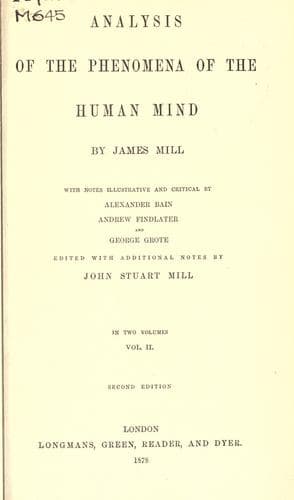
Analysis of the Phenomena of the Human MindMill, James
PhilosophyPhilosophy
Analysis of the Phenomena of the Human Mind
Mill, James
Psychology
2. "Wherefore these intelligible ideas or essences of things, those
forms by which we understand all things, exist nowhere but in the
mind itself: for it was very well determined long ago by Socrates,
in Plato's Parmenides, that these things are nothing but _noëmata_:
these species or ideas are all of them nothing but _noëmata_, or
notions that exist nowhere but in the soul itself."
Now, neither of these assertions of Cudworth will be found accurate:
neither the "determination" which he ascribes to the Platonic
Sokrates--nor the censure of "unjust or unskilful" which he attaches
to Aristotle. It is indeed true that the opinion here mentioned is
enunciated by Sokrates in Plato's Parmenides. But far from being
given as a "determination," it is enunciated only to be refuted and
dropt.[a] In that dialogue, Sokrates is introduced as a youthful and
ardent aspirant in philosophy, maintaining the genuine Platonic
theory of self-existent and separate Ideas. He finds himself unable
to repel several acute objections tendered against the theory by the
veteran Parmenides: he is driven from position to position: and one
among them, not more tenable than the rest, is the suggestion cited
by Cudworth. Yet Parmenides, though his objections remain unanswered
and though he alludes to others {274} not specified,--concludes by
declaring[b] that nevertheless the Platonic theory of Ideas cannot
be abandoned: it must be upheld as a postulate essential to the
possibility of general reasoning and philosophy.
[Footnote a: Plato Parmenid. p. 132, C, D.]
[Footnote b: Plato Parmenid. p. 135, B, C.
I have given an account of this acute but perplexing dialogue, in
the twenty-fifth chapter of my work on Plato and the other
Companions of Sokrates.]
Even in the Parmenides itself, therefore, where Plato accumulates
objections against the theory of separate and self-existent Ideas,
we still find him reiterating his adherence to it. And when we turn
to his other dialogues, Phædrus, Phædon, Symposion, Republic,
Kratylus, &c., we see that theory so emphatically proclaimed and so
largely illustrated, that I wonder how Cudworth can blame Aristotle
for imputing it to him.
It is by Cudworth, probably, that Mr. James Mill has been misled,
when he says--p. 249--"At bottom, Aristotle's [Greek: ei)=dos] is
the same as with Plato's [Greek: i)de/a], though Aristotle makes a
great affair of some very trifling differences, which he creates and
sets up between them."--I have pointed out Cudworth's mistake, and I
maintain that the difference between Plato and Aristotle on this
subject was grave and material. The latter denied, what the former
affirmed, self-existence and substantiality of the Universal Ideas,
apart from and independent of particulars.
Public-domain text, read in full here on John Shaqi.
Reviews
Reviews
No reviews yet
Be the first to share your thoughts on this work.
Elsewhere in the archive
Join the Discussion
Join the discussion
Sign in to leave a comment or review.
Sign InorCreate an account