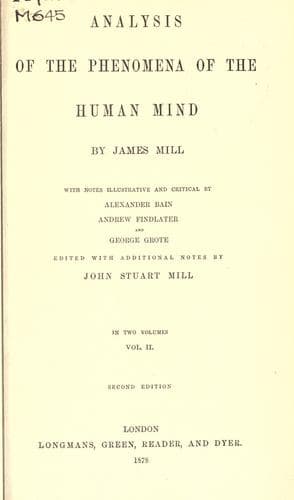
Analysis of the Phenomena of the Human MindMill, James
PhilosophyPhilosophy
Analysis of the Phenomena of the Human Mind
Mill, James
Psychology
The reader would take very inadequate measure of these {272} ancient
philosophers, if he judged them from the two citations out of Harris
and Cudworth, produced by Mr. James Mill as setting forth the most
successful speculations of the ancient world. Both these passages
are brought to illustrate "the mystical jargon" (p. 253) with which
the ancients are said to have obscured a clear and simple subject.
The mysticism in both citations is to a certain extent real; but it
depends also in part on the use of a terminology now obsolete,
rather than on confusion of ideas. In regard to the citation from
Harris, it is a passage in which that author passes into theology,
and includes God and Immortality: topics upon which mystical
language can seldom be avoided: moreover, if we compare the remarks
on Harris (p. 251) with p. 271, we shall find Mr. James Mill
ridiculing as mystical, when used by Harris, the same language
(about "the One in the Many") which, when employed by Plato, he
eulogises as follows--"a phrase which, when stripped from the
subtleties of the sophists whom he (Plato) exposed, and from the
mystical visions of his successors, of which he never dreamed, is
really a striking expression of what in classification is the matter
of fact."
I wish I could concur with Mr. James Mill in exonerating Plato from
these mystical visions, and imputing them exclusively to his
successors. But I find them too manifestly proclaimed in the Timæus,
Phædon, Phædrus, Symposion, Republic, and other dialogues, to admit
of such an acquittal: I also find subtleties quite as perplexing as
those of any sophist whom he exposed. Along with these elements, the
dialogues undoubtedly present others entirely disparate, much
sounder and nobler. I have in another work endeavoured to render a
faithful account of the multifarious Platonic aggregate, stamped in
all its parts,--whether of negative dialectic, poetical fancy, or
ethical dogmatism,--with the unrivalled genius of expression
belonging to the author. The misfortune is that his Neo-Platonic
successors selected by preference his dreams and visions for their
amplifying comment and eulogy, leaving comparatively unnoticed the
instructive lessons of philosophy {273} accompanying them. To this
extent the Neo-Platonists fully deserve the criticism here bestowed
on them.
The long passage, extracted in the Analysis from Cudworth, contains
two grave mis-statements, respecting both Plato and Aristotle; which
deserve the more attention because they seem to have misled Mr.
James Mill himself. Respecting Universals, Cudworth, after saying
that they do not exist in the individual sensibles, proceeds as
follows (p. 255-256)--
1. "Neither, in the next place, do they exist somewhere else apart
from the individual sensibles, and without the mind: which is that
opinion that Aristotle justly condemns, but either unjustly or
unskilfully attributes to Plato.
Public-domain text, read in full here on John Shaqi.
Reviews
Reviews
No reviews yet
Be the first to share your thoughts on this work.
Elsewhere in the archive
Join the Discussion
Join the discussion
Sign in to leave a comment or review.
Sign InorCreate an account