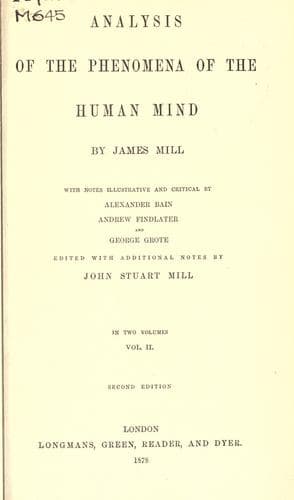
Analysis of the Phenomena of the Human MindMill, James
PhilosophyPhilosophy
Analysis of the Phenomena of the Human Mind
Mill, James
Psychology
The manner in which this scientific improvement takes place is by
the resolution of phenomena which {vi} are special and complex into
others more general and simple. Two cases of this sort may be
roughly distinguished, though the distinction between them will not
be found on accurate examination to be fundamental. In one case it
is the order of the phenomena that is analysed and simplified; in
the other it is the phenomena themselves. When the observed facts
relating to the weight of terrestrial objects, and those relating to
the motion of the heavenly bodies, were found to conform to one and
the same law, that of the gravitation of every particle of matter to
every other particle with a force varying as the inverse square of
the distance, this was an example of the first kind. The order of
the phenomena was resolved into a more general law. A great number
of the successions which take place in the material world were shewn
to be particular cases of a law of causation pervading all Nature.
The other class of investigations are those which deal, not with the
successions of phenomena, but with the complex phenomena themselves,
and disclose to us that the very fact which we are studying is made
up of simpler facts: as when the substance Water was found to be an
actual compound of two other bodies, hydrogen and oxygen; substances
very unlike itself, but both actually present in every one of its
particles. By processes like those employed in this case, all the
variety of substances which meet our senses and compose the planet
on which we live, have been shewn to be {vii} constituted by the
intimate union, in a certain number of fixed proportions, of some
two or more of sixty or seventy bodies, called Elements or Simple
Substances, by which is only meant that they have not hitherto been
found capable of further decomposition. This last process is known
by the name of chemical analysis: but the first mentioned, of which
the Newtonian generalization is the most perfect type, is no less
analytical. The difference is, that the one analyses substances into
simpler substances; the other, laws into simpler laws. The one is
partly a physical operation; the other is wholly intellectual.
Both these processes are as largely applicable, and as much
required, in the investigation of mental phenomena as of material.
And in the one case as in the other, the advance of scientific
knowledge may be measured by the progress made in resolving complex
facts into simpler ones.
Public-domain text, read in full here on John Shaqi.
Reviews
Reviews
No reviews yet
Be the first to share your thoughts on this work.
Join the Discussion
Join the discussion
Sign in to leave a comment or review.
Sign InorCreate an account