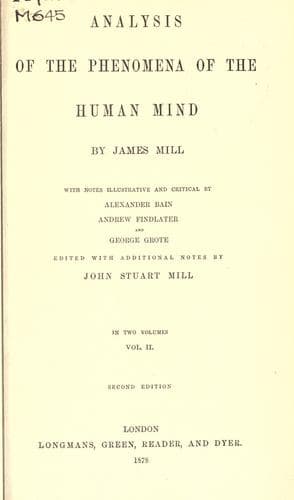
Analysis of the Phenomena of the Human MindMill, James
PhilosophyPhilosophy
Analysis of the Phenomena of the Human Mind
Mill, James
Psychology
There is one other remark to be made, respecting the view of
Classification presented in the eighth Chapter of the Analysis. We
read in the beginning of that Chapter--p. 249--"Forming a class of
things is a mode of regarding them. But what is meant by a mode of
regarding things? This is mysterious: {283} and is as mysteriously
explained, when it is said to be the taking into view the
particulars in which individuals agree. For what is there which it
is possible for the mind to take into view, in that in which
individuals agree? Every colour is an individual colour, every size
is an individual size, every shape is an individual shape. But
things have no individual colour in common, no individual shape in
common, no individual size in common: that is to say, they have
neither shape, colour, nor size in common. What then is it which
they have in common which the mind can take into view? Those who
affirmed that it was something, could by no means tell. They
substituted words for things: using vague and mystical phrases,
which when examined meant nothing."
Here we find certain phrases, often used both in common speech and
in philosophy, condemned us mystical and obscure. In the next or
ninth Chapter (on Abstraction, p. 295 seq.), we shall see the
language substituted for them, and the theory by which the mystery
is supposed to be removed. I cannot but think that the theory of Mr.
James Mill himself is open to quite as many objections as that which
he impugns. He finds fault with those who affirm that the word
_cube_ or _sphere_ is applied to a great many different objects by
reason of the shape which they have in common; and that they may be
regarded so far forth as _cube_ or _sphere_. But surely this would
not have been considered as either incorrect or mysterious by any
philosopher, from Aristotle downward. When I am told that it is
incorrect, because the shape of each object is an _individual_
shape, I dissent from the reason given. In my judgment, the term
_individual_ is a term applicable, properly and specially, to a
concrete object--to that which Aristotle would have called a Hoc
Aliquid. The term is not applicable to a quality or attribute. The
same quality that belongs to one object, may also belong to an
indefinite number of others. It is this common quality that is
_connoted_ (in the sense of that word employed by Mr. John Stuart
Mill) by the class-term: and if there were no common quality, the
class-term would have no connotation. In other words, there would be
no class: nor {284} would it be correct to apply to any two objects
the same concrete appellative name.
Public-domain text, read in full here on John Shaqi.
Reviews
Reviews
No reviews yet
Be the first to share your thoughts on this work.
Elsewhere in the archive
Join the Discussion
Join the discussion
Sign in to leave a comment or review.
Sign InorCreate an account