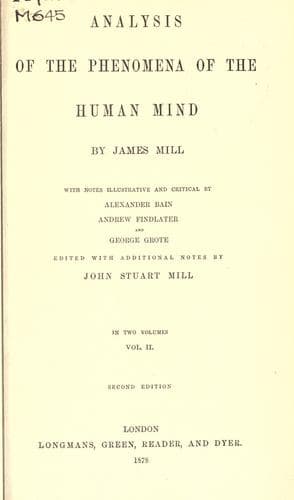
Analysis of the Phenomena of the Human MindMill, James
PhilosophyPhilosophy
Analysis of the Phenomena of the Human Mind
Mill, James
Psychology
But when we come to the following Chapter of the Analysis (ch. ix.
on Abstraction, p. 296), we read as follows--"Let us suppose that
we apply the adjective _black_ first to the word Man. We say 'black
man.' But we speedily see that _for the same reason_ for which we
say black man, we may say black horse, black cow, black coat, and so
on. The word _black_ is thus associated with innumerable
modifications of the sensation black. By frequent repetition, and
the gradual strengthening of the association, these modifications
are at last called up in such rapid succession that they appear
commingled, and no longer many ideas, but one. _Black_ is therefore
no longer an individual, but a general name. It marks not the
particular black of a particular individual, but the black of every
individual and of all individuals."
To say that we apply the word _black_ to the horse _for the same
reason_ as we applied it to the man, is surely equivalent to saying
that the colour of the horse is the same as that of the man: that
blackness is the colour which they have in common. It is quite true
that we begin by applying the name to one individual object, then
apply it to another, and another, &c.; but always for the same
reason--to designate (or _connote_, in the phraseology of Mr. John
Stuart Mill) the same colour in them all, and to denote the objects
considered under one and the same point of view. It may be that in
fact there are differences in shade of colour: but the class-name
leaves these out of sight. When we desire to call attention to them,
we employ other words in addition to it. Every attribute is
considered and named as One, which is or may be common to many
individual objects: the objects only are individual.
It is to be regretted, I think, that Mr. James Mill disconnected
Classification so pointedly from Abstraction, and insisted on
explaining the former without taking account of the latter. Such
disconnection is a novelty, as he himself states (p. 294): previous
expositors thought that "abstraction was included in
classification"--and, in my judgment, they were {285} right in
thinking so, if (with Mr. James Mill) we are to consider
Classification as a "great operation." An aggregate of concretes is
not sufficient to constitute a Class, in any scientific sense, or as
available in the march of reasoned truth. You must have, besides,
the peculiar mode of regarding the aggregate: (a phrase which Mr.
James Mill deprecates as mysterious, but which it is difficult to
exchange for any other words more intelligible) you must have "that
separating one or more of the ingredients of a complex idea from the
rest, which has received the name of Abstraction"--to repeat the
very just explanation given by him, p. 295--though that too, if we
look at p. 249, he seems to consider as tainted with mystery.
Public-domain text, read in full here on John Shaqi.
Reviews
Reviews
No reviews yet
Be the first to share your thoughts on this work.
Elsewhere in the archive
Join the Discussion
Join the discussion
Sign in to leave a comment or review.
Sign InorCreate an account