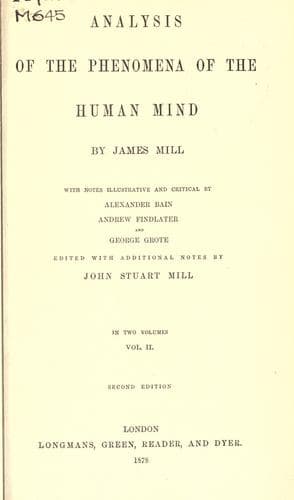
Analysis of the Phenomena of the Human MindMill, James
PhilosophyPhilosophy
Analysis of the Phenomena of the Human Mind
Mill, James
Psychology
It is proper to add, that the class-name is not solely a mark of the
distinguishing class-attributes, it is a mark also of the objects.
The name man does not merely signify the qualities of animal life,
rationality, and the human form, it signifies all individual men. It
even signifies these in a more direct way than it signifies the
attributes, for it is predicated of the men, but not predicated of
the attributes; just as the proper name of an individual man is
predicated of him. We say, This is a man, just as we say, This is
John Thompson: and if John Thompson is the name of one man, Man is,
in the same manner, a name of all men. A class name, being thus a
name of the various objects composing the class, signifies two
distinct things, in two different modes of signification. It
signifies the individual objects which are the class, and it
signifies the common attributes which constitute the class. It is
predicated only of the objects; but when predicated, it conveys the
information that these objects possess those attributes. Every
concrete class-name is thus a connotative name. It marks {291} both
the objects and their common attributes, or rather, that portion of
their common attributes in virtue of which they have been made into
a class. It _denotes_ the objects, and, in a mode of speech lately
revived from the old logicians, it _connotes_ the attributes. The
author of the Analysis employs the word connote in a different
manner; we shall presently examine which of the two is best.
We are now ready to consider whether the author's account of the
ideas connected with General Names is a true and sufficient one. It
is best expressed in his own words. "The word Man, we shall say, is
first applied to an individual; it is first associated with the idea
of that individual, and acquires the power of calling up the idea of
him; it is next applied to another individual, and acquires the
power of calling up the idea of him; so of another, and another,
till it has become associated with an indefinite number, and has
acquired the power of calling up an indefinite number of those ideas
indifferently. What happens? It does call up an indefinite number of
the ideas of individuals, as often as it occurs, and calling them up
in close connexion, it forms them into a species of complex idea. .
. . When the word man calls up the ideas of an indefinite number of
individuals, not only of all those to whom I have individually given
the name, but of all those to whom I have in imagination given it,
or imagine it will ever be given, and forms all those ideas into
one,--it is evidently a very complex idea, and therefore indistinct;
and this indistinctness has doubtless been the main cause of the
mystery which has appeared to belong to it. That this however is the
process, is an inevitable result of the laws of association."
Public-domain text, read in full here on John Shaqi.
Reviews
Reviews
No reviews yet
Be the first to share your thoughts on this work.
Elsewhere in the archive
Join the Discussion
Join the discussion
Sign in to leave a comment or review.
Sign InorCreate an account