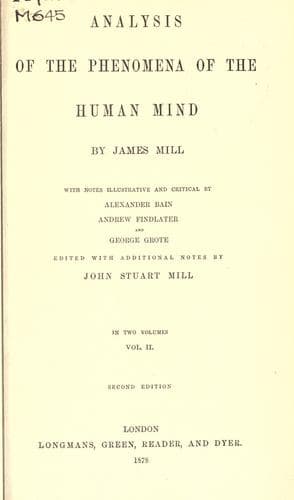
Analysis of the Phenomena of the Human MindMill, James
PhilosophyPhilosophy
Analysis of the Phenomena of the Human Mind
Mill, James
Psychology
Nominalists, nor abstract ideas excluding all properties not common
to the class, such as Locke's famous Idea of a triangle that is
neither equilateral nor isosceles nor scalene. We cannot represent
to ourselves a triangle with no properties but those common to all
triangles: but we may represent it to ourselves sometimes in one of
those three forms, sometimes in another, being aware all the while
that all of them are equally consistent with its being a triangle.
One important consequence of these considerations is, that {290} the
meaning of a class-name is not the same thing with the complex idea
associated with it. The complex idea associated with the name man,
includes, in the mind of every one, innumerable simple ideas besides
those which the name is intended to mark, and in the absence of
which it would not be predicated. But this multitude of simple ideas
which help to swell the complex idea are infinitely variable, and
never exactly the same in any two persons, depending in each upon
the amount of his knowledge, and the nature, variety, and recent
date of his experience. They are therefore no part of the meaning of
the name. They are not the association common to all, which it was
intended to form, and which enables the name to be used by all in
the same manner, to be understood in a common sense by all, and to
serve, therefore, as a vehicle for the communication, between one
and another, of the same thoughts. What does this, is the nucleus of
more closely associated ideas, which is the constant element in the
complex idea of the class, both in the same mind at different times,
and in different minds.
Public-domain text, read in full here on John Shaqi.
Reviews
Reviews
No reviews yet
Be the first to share your thoughts on this work.
Elsewhere in the archive
Join the Discussion
Join the discussion
Sign in to leave a comment or review.
Sign InorCreate an account