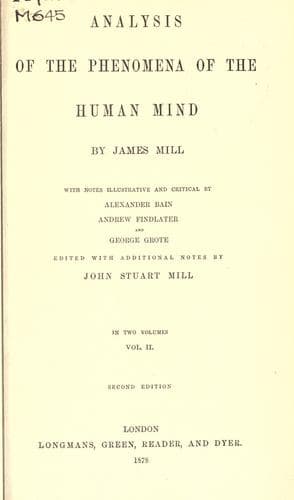
Analysis of the Phenomena of the Human MindMill, James
PhilosophyPhilosophy
Analysis of the Phenomena of the Human Mind
Mill, James
Psychology
Thus the word, black, NOTES that of which black is more peculiarly
the name, a particular colour; it CONNOTES the clusters with the
names of which it is joined: in the expression, black man, it
connotes man; black horse, it connotes horse; and so of all other
cases. The ancient Logicians used these terms, in the inverse order;
very absurdly, in my opinion.[82]
[Editor's footnote 82: The word Connote, with its substantive
Connotation, was used by the old logicians in two senses; a wider,
and a narrower sense. The wider is that in which, up to this place,
the author of the Analysis has almost invariably used it; and is the
sense in which he defined it, in a note to section *5 of his first
chapter. "There is a large class of words which denote two things
both together; but the one perfectly distinguishable from the other.
Of these two things, also, it is observable, that such words express
the one primarily as it were; the other in a way which may be called
secondary. Thus white, in the phrase white horse, denotes two
things, the colour and the horse; but it denotes the colour
primarily, the horse secondarily. We shall find it very convenient
to say, therefore, that it _notes_ the primary, _connotes_ the
secondary signification."
This use of terms is attended with the difficulty, that it may often
be disputed which of the significations is primary and which
secondary. In the example given, most people would agree with the
author that the colour is the primary signification; the word being
associated with the objects, only through its previous association
with the colour. But take the other of the two words, horse. That
too is connotative, and in the same manner. It signifies any and
every individual horse, and it also signifies those attributes
common to horses, which led to their being classed together and
receiving that common name. Which, in this case, is the primary, and
which the secondary signification? The author would probably say,
that in this case, unlike the other, horse is the primary
signification, the attributes the secondary. Yet in this equally
with the former case, the attributes are the foundation of the
meaning: a thing is called a horse to express its resemblance to
other horses; and the resemblance consists of the common attributes.
The question might be discussed, pro and con, by many arguments,
without any conclusive result. The difference between primary and
secondary acceptations is too uncertain, and at best too
superficial, to be adopted as the logical foundation of the
distinction between the two modes of signification.
Public-domain text, read in full here on John Shaqi.
Reviews
Reviews
No reviews yet
Be the first to share your thoughts on this work.
Elsewhere in the archive
Join the Discussion
Join the discussion
Sign in to leave a comment or review.
Sign InorCreate an account