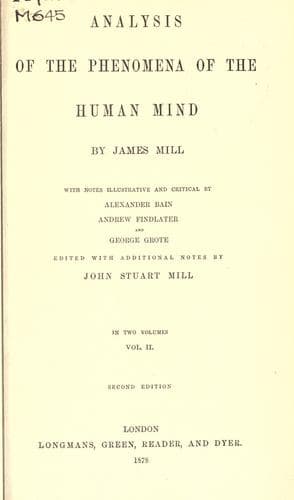
Analysis of the Phenomena of the Human MindMill, James
PhilosophyPhilosophy
Analysis of the Phenomena of the Human Mind
Mill, James
Psychology
The author, however, has, throughout the preceding chapters,
regarded words as _connoting_ any number of things which though
included in their signification, are not, in his judgment, what they
primarily signify. He said, for example, that a verb notes an
action, and connotes the agent (as either me, thee, or some third
person), the number of agents (as one or more), the time (as past,
present, or future), and three modes, "that in which there is no
reference to anything preceding, that in which there is a reference
to something preceding, and that in which reference is made to the
will of one of the Persons." I cite this complicated case, to shew
by a striking example the great latitude with which the author uses
the word Connote.
But in the present chapter he follows the example of some of the old
logicians in adopting a second and more restricted meaning,
expressive of the peculiar connotation which belongs to all concrete
general names; viz. that twofold manner of signification, by which
every name of a class signifies, on the one hand, all and each of
the individual things composing the class, and on the other hand the
common attributes, in consideration of which the class is formed and
the name given, and which we intend to affirm of every object to
which we apply the name. It is difficult to overrate the importance
of keeping in view this distinction, or the danger of overlooking it
when not made prominent by an appropriate phrase. The word Connote,
which had been employed for this purpose, had fallen into disuse.
But, though agreeing with the old logicians in using the word
Connote to express this distinction, the author exactly reverses
their employment of it. In their phraseology, the class-name
connotes the attributes: in his, it notes the attributes, and
connotes the objects. And he declares that in his opinion, their
mode of employing the term is very absurd.
We have now to consider which of these two modes of employing it is
really the most appropriate.
Public-domain text, read in full here on John Shaqi.
Reviews
Reviews
No reviews yet
Be the first to share your thoughts on this work.
Elsewhere in the archive
Join the Discussion
Join the discussion
Sign in to leave a comment or review.
Sign InorCreate an account