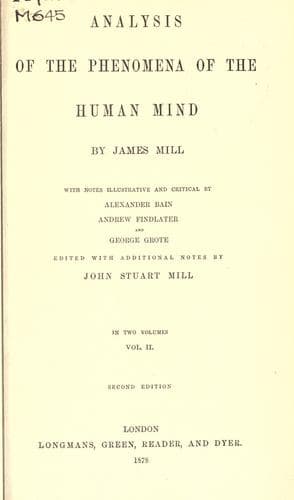
Analysis of the Phenomena of the Human Mind — John Shaqi
Analysis of the Phenomena of the Human MindMill, James
PhilosophyPhilosophy
Analysis of the Phenomena of the Human Mind
Mill, James
Psychology
In the author's footnote he recognises that the abstract power of
smelling enters into this particular application of the word Smell;
and refers to a subsequent part of the treatise for the meaning of
Power. But he thinks that along with the power, or as part of the
conception of Power, the material organ is also signified. It seems
to me that the organ does not enter in either of these modes, into
the signification of the word. We can imagine ourselves ignorant
that we possess physical organs; or aware that we possess them, but
not aware that our sensations of smell are connected with them. Yet
on either of these suppositions the "power of smelling" would be
perfectly intelligible, and would have the same meaning to us which
it has now.--_Ed._]
{15} In the phrases in which smell is called a SENSE, as when we
say, that smell is one of the five senses, there is considerable
complexity. The term here imports the _organ_, it imports the
_sensation_, and, in a certain way, it imports also the _object_.
It imports the organ as existing continuously, the sensation as
existing only under a certain condition, and that condition the
presence of the object.[2*]
[Mill's footnote 2: It will naturally occur to some of my readers,
that, in the term sense of smelling, the idea of power is also
included. They will say, that when we speak of the sense of
smelling, we mean not only the organ, but the function of the organ,
or its power of producing a certain effect. This is undoubtedly
true; but when the real meaning of the language is evolved, it only
amounts to that which is delivered in the text. For what does any
person mean when he says that, in the sense of smelling, he has the
power of smelling? Only this, that he has an organ, and that when
the object of that organ is presented to it, sensation is the
consequence. In all this, there is nothing but the organ, the
object, and the sensation, conceived in a certain order. This will
more fully appear when the meaning of the relative terms, cause and
effect, has been explained.--(_Author's Note_.)]
{16} SECTION II.
HEARING.
In Hearing, the same three particulars, the ORGAN, the OBJECT, and
the FEELING, require to be distinguished.
The name of the organ is the Ear; and its nice and complicated
structure has been described with minuteness and admiration by
anatomists and physiologists.
Public-domain text, read in full here on John Shaqi.
Reviews
Reviews
No reviews yet
Be the first to share your thoughts on this work.
Join the Discussion
Join the discussion
Sign in to leave a comment or review.
Sign InorCreate an account