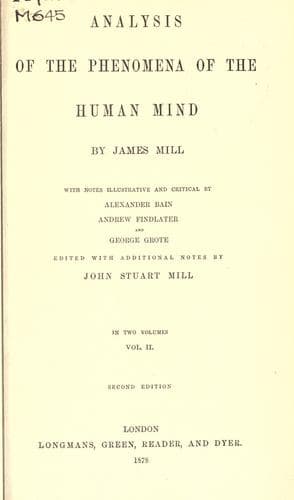
Analysis of the Phenomena of the Human MindMill, James
PhilosophyPhilosophy
Analysis of the Phenomena of the Human Mind
Mill, James
Psychology
The structure of these derivatives is better seen in some of the
other Teutonic dialects than in the English or the Anglo-Saxon,
in which the affix is reduced to a mere consonant. Thus, for Eng.
_depth_ the Gothic has _diupi-tha_; for _heigh-th_, _hauhi-tha_.
In Old High German the affix _-tha_ becomes _-da_, and we have
_heili-da_ corresponding to Eng. _heal-th_; _strenki-da_, to
_streng-th_; besides a great number of analogous forms, such as
_evi-da_, "eternity" (from the same root as _ever_; compare Lat.
_aetas_ for _aevitas_). In modern German comparatively few of these
derivatives survive; and in those that do; the _-da_ of the Old
German has passed into _-de_, as in _ge-baer-de_, the way of
'bearing' oneself, behaviour; equivalent to Latin _habi-tus_. The
modern German equivalents of _bread-th_, _leng-th_, are _breit-e_,
_läng-e_; but in some of the popular dialects the older forms
_breite de_, _läng-de_ are still retained; and in Dutch _warm-te_
corresponds to _warm-th_, and _grôt-te_ is _great-ness_. When we
recollect that _th_ or _d_ in the Germanic languages represents in
such cases the _t_ of the Greek and Latin (compare Gr. [Greek:
me/lit (os)], honey with Goth. _milith_; Lat. _alter_ with Eng.
_other_), we cannot help seeing how analogous is the formation of
the class of words we are now considering to that of Latin past
participles (ama-tus, dic-tus, audi-tus). In the case of those
abstracts that seem to come more naturally from an adjective root
than from a verb, we can conceive the adjective formed on the
analogy of the past participle; just as there are in English
adjectives having no possible verbal root, yet simulating past
participles; as _able-bodi-ed_, _three-corner-ed_. The abstract noun
would appear to have been originally distinguished from the
participle, or participial adjective, by some additional affix, as
in lec-t-io. In Greek and Latin this additional affix very often
consisted in a reduplication of the formative element _t_, as if for
the purpose of denoting multitude, generality; as in Greek ([Greek:
neo/-têt-os]), Latin _juven-tut-is_, _sani-tat-is_. It is not
impossible that Goth. _diupi-tha_, O.H.G. _heili-da_ are
abbreviations of _diupi-tha-th_, _heili-da-d_, just as Lat.
_sani-tat_ has dwindled down in modern Ital. to _sani-tà_.
In a great many words essentially belonging to the same class both
in meaning and in mode of formation, the _-th_ has, for the sake of
euphony or from other causes, given place to _t_ or _d_. Thus _mood_
corresponds to Goth. _mo-th_, and means a motion (Lat. _motus_) or
affection (of the mind); _blood_, to Goth. _blo-th_; _theft_, is in
Ang. Sax. _theof-th_. _Mur-ther_, from a root akin to Lat. _mori_;
_burthen_, from the root of to _bear_, are of similar formation,
with additional affixes.
Public-domain text, read in full here on John Shaqi.
Reviews
Reviews
No reviews yet
Be the first to share your thoughts on this work.
Elsewhere in the archive
Join the Discussion
Join the discussion
Sign in to leave a comment or review.
Sign InorCreate an account