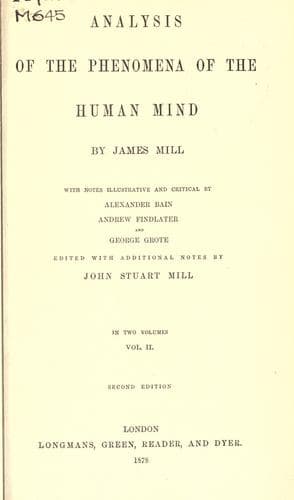
Analysis of the Phenomena of the Human MindMill, James
PhilosophyPhilosophy
Analysis of the Phenomena of the Human Mind
Mill, James
Psychology
All these considerations would seem to put Horne Tooke's proposed
derivation of these abstracts from the third person singular of the
present indicative of the verb, completely out of court. The famous
case of _truth_ from _troweth_ is especially absurd. For one thing
the Ang. Sax. verb _treowan_ does not mean "to think," but "to
trust," "rely on," "believe." This implies a ground for the trust,
and that ground lies in the quality expressed by the adjective,
true. _Truth_ has the same relation, logically and etymologically,
to _true_, that _dearth_ has to _dear_, _health_ to _hale_.
Remarking on the identity in form between the Ang. Sax. _treow_,
"trust," "a treaty," and _treow_, "a tree," Jacob Grimm suggests
that they are radically related, and that the idea common to _tree_
and _true_ is firmness, fixedness. Thus the "true" would be the
"firm" the "fixed"--what may be relied on. This view is supported by
the analogy of the Lat. _robur_, which means both an oak and
strength.--_F._]
{311} It would be interesting to give a systematic account of the
non-connotatives, derived from English {312} verbs; and this ought
to be done; but for the present inquiry it would be an operation
misplaced. The nature of the words, and the mode of their
signification, is all which here is necessary to be understood.
One grand class of connotative terms is composed of such words as
the following: walking, running, flying, reading, striking; and we
have seen that, for a very obvious utility, a generical name was
invented, the word ACTING, which includes the whole of these
specific names; and to which the non-connotative, or abstract term
ACTION corresponds. There was equal occasion for a generical name to
include all the specific names belonging to the other class of
connotative terms; such as coloured, sapid, hard, soft, hot, cold,
and so on. But language has by no means been so happy in a general
name for this, as for the other class. The word SUCH, is a
connotative term, which includes them all, and indeed the other
class along with them; for when we apply the word SUCH to any thing,
we comprehend under it all the ideas of which the cluster {313} is
composed. But this is not all which is included under the word such.
It is a relative term, and always connotes so much of the meaning of
some other term. When we call a thing _such_, it is always
understood that it is such _as_ some other thing. Thus we say, John
is such as James. Corresponding with our "such as," the Latins had
_talis qualis_. If we could suppose _qualis_ to have been used
without any connotation of _talis_, _qualis_ would have been such a
word as the occasion which we are now considering would have
required. The Latins did not use _qualis_, in this sense, as a
general concrete, including all the other names of the properties of
objects other than actions. But they made from it, as if used in
that very sense, a non-connotative or abstract term, the word
Public-domain text, read in full here on John Shaqi.
Reviews
Reviews
No reviews yet
Be the first to share your thoughts on this work.
Elsewhere in the archive
Join the Discussion
Join the discussion
Sign in to leave a comment or review.
Sign InorCreate an account