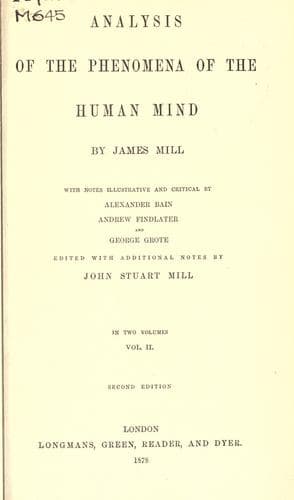
Analysis of the Phenomena of the Human MindMill, James
PhilosophyPhilosophy
Analysis of the Phenomena of the Human Mind
Mill, James
Psychology
Another distinction is here suggested between the memory of a
sensation and the memory of an idea. The complex idea, which needs
to be associated with a mere simple idea, to make it memory, is not
the same in the two cases. There is a specific difference. The self
which is at the antecedent end of the associated train, (in the case
of sensation,) is the sentient self; that is, seeing or hearing; the
self at the antecedent end of the associated train, (in the case of
ideas,) is not the sentient self, but the conceptive self, self
having an idea. But myself percipient, and my self imagining or
conceiving, are two very different states of consciousness: of
course the ideas of these states of consciousness, or these states
revived by association, are very different ideas.
The simplest of all cases of memory is that of a sensation
immediately past. I have one sensation, and another sensation; call
them A and B; and I recognise them as successive. Every man has
experience of the fact, and is familiar with it. But not every man
can tell what it involves.
When a sensation ceases, it is as completely gone, as if it had
never existed.[93] It is, in a certain sense, {337} revived again in
its idea. But that idea must be called into existence by something
with which it is associated. In my two sensations, supposed above,
the one antecedent, the other consequent, how do I recognise the
succession; if the first is gone, before the coming of the second?
It is evident that it must be by memory. And how by memory? The
preceding developments seem to make the process clear. The
consciousness of the present moment calls up the idea of the
consciousness of the preceding moment. The consciousness of the
present moment is not absolutely simple; for, whether I have a
sensation or idea, the idea of what I call Myself is always
inseparably combined with it. The consciousness, then, of the second
of the two moments in the case supposed, is the sensation combined
with the idea of Myself, which compound I call "Myself Sentient."
This "Self Sentient," in other words sensation B, combined with the
idea of self, calls up the idea of sensation A combined with the
idea of self. This we call MEMORY; and, there being no intermediate
link, _immediate_ MEMORY. Suppose that, instead of two sensations,
there had been three, A, B, C. In order {338} to remember A, it is
necessary to step over B. The consciousness of the third moment,
namely, "sensation C, united with the idea of self," calls up the
idea of "sensation A, united with the idea of self," and along with
this the intermediate state of consciousness, "B, with the constant
concomitant self." If the intermediate state, B, were not included,
the sensation A would appear to have immediately preceded sensation
C, and the memory would be inaccurate.
Public-domain text, read in full here on John Shaqi.
Reviews
Reviews
No reviews yet
Be the first to share your thoughts on this work.
Elsewhere in the archive
Join the Discussion
Join the discussion
Sign in to leave a comment or review.
Sign InorCreate an account