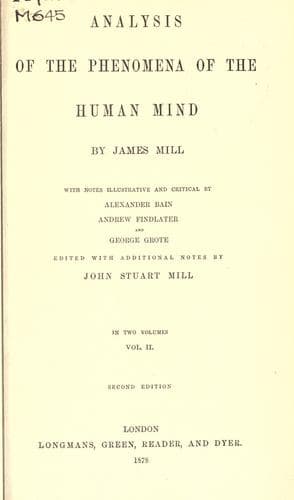
Analysis of the Phenomena of the Human MindMill, James
PhilosophyPhilosophy
Analysis of the Phenomena of the Human Mind
Mill, James
Psychology
[Bain's footnote 93: This is a statement that should be qualified.
Looking to the change of outward situation, we may say that the
difference between the present reality, and the idea of it when
past, is total and vast: the wide prospect before the eyes at one
moment is gone, annihilated, non-existent. But looking at the mental
process, we must use more moderate language. The mind does not adapt
itself to the new situation with the same rapidity. If one is very
much impressed with a picture, one maintains the rapt attitude for a
little time, after the picture is withdrawn, and only by degrees
loses the hold in favour of the next thing presented to the view. It
is possible for us to resist the solicitation of the actual scene,
and to be absorbed to the full measure of actuality by something no
longer actual. The immediate past may still divide the empire with
the present. The psychological transition follows a different law
from the objective transition: a circumstance in no small degree
involved in the subtle question of our mental continuity or personal
identity.--_B._]
We have thus carried the analysis of Memory to a certain point. We
have found the association to consist of three parts; the
remembering self; the remembered self; and the train which
intervened. Of these three parts, the last has been fully expounded.
The recalling of the successive states of consciousness, which
composed the intervening train, is an ordinary case of association.
The other parts, _the two selfs_, at the two extremities of this
train, require further consideration. The self, at the first end, is
the remembered self; the _self which had a sensation, or an idea_.
The idea of this self, therefore, consists of two parts: of self,
and a sensation, or an idea. The last-mentioned part of this
combination, the sensation or idea, needs no explanation; the first,
that which is called self, does. The self at the other extremity of
the chain of consciousness, is the _remembering self_. Remembering
is associating. The idea of this self, then, is the combination of
self with the idea of associating. And here, too, associating needs
no explanation; it is the other part of the combination that does.
The analysis, then, of SELF, or the account of what is included in
that state of consciousness commonly {339} called the _idea of
personal identity_, is still wanting to the complete developement of
Memory.
Philosophers tell us also, that the idea of _Time_ is included in
every act of MEMORY; and again, that it is from MEMORY we obtain our
idea of _Time_: thus asserting that the idea of _Time_ must precede
MEMORY, and that MEMORY must precede the idea of _Time_. These
contradicting propositions imply that the idea of Time in the minds
of those who make them, is a very confused idea. Nevertheless, as
there can be no memory without the idea called Time, the exposition
of that idea, likewise, is necessary to the full understanding of
Memory.
Public-domain text, read in full here on John Shaqi.
Reviews
Reviews
No reviews yet
Be the first to share your thoughts on this work.
Elsewhere in the archive
Join the Discussion
Join the discussion
Sign in to leave a comment or review.
Sign InorCreate an account