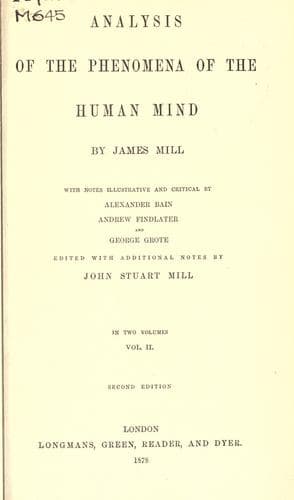
Analysis of the Phenomena of the Human MindMill, James
PhilosophyPhilosophy
Analysis of the Phenomena of the Human Mind
Mill, James
Psychology
{343} It may be alleged that, when I say "I have a sensation,"
I express the simple feeling, as derived from the outward sense;
but that when I say "I believe I have a sensation," I express two
things, the simple sensation, and the association with it, of that
remarkable idea, the idea of myself. The association, however, is
the same in both cases. As I never have the sensation of an object,
the sight, for example, of a rose, without associating with it, the
idea of position, and also that of unity; nor the _idea_ of such an
object, without the same association; so I never have a sensation,
nor the idea of that sensation, without associating with it, the
idea of myself. And in both cases, the associations are of that
remarkable class, which we have denominated inseparable. It is not
in our power to prevent them. Whensoever the perception of the
object exists, the idea of its position is sure to exist along with
it; whensoever one of my sensations exists, the idea of myself
exists along with {344} it; whensoever one of my _ideas_ exists, the
idea of myself is sure to exist along with it.
In the case, then, of a present sensation, and that of a present
idea; the sensation, and the belief of the sensation; the idea, and
the belief of the idea, are not two things; they are, in each case,
one and the same thing; a single thing, with a double name.
The several cases of Belief may be considered under three heads:
I., Belief in events, real existences; II., Belief in testimony; and
III., Belief in the truth of propositions. We shall consider them in
their order; and first, Belief in events, real existences.
I. This is subdivided into three distinct cases: 1, Belief in
present events; 2, Belief in past events; 3, Belief in future
events.
1. Belief in present events, again, is divided into two cases:
1, Belief in immediate existences present to my senses; 2, Belief in
immediate existences not present to my senses.
Belief in existences present to my senses, includes, for one
element, belief in my sensations; and belief in my sensations, as we
have just observed, is only another name for having the sensations.
But belief in the external objects, is not simply belief in my
present sensations; it is this, and something more. The something
more, is now the object of our inquiry. I see, for example, a rose:
my sensation is a sensation of sight: that of a certain modification
of light; but my belief of the rose is not this; it is this, and
much more.
Public-domain text, read in full here on John Shaqi.
Reviews
Reviews
No reviews yet
Be the first to share your thoughts on this work.
Elsewhere in the archive
Join the Discussion
Join the discussion
Sign in to leave a comment or review.
Sign InorCreate an account