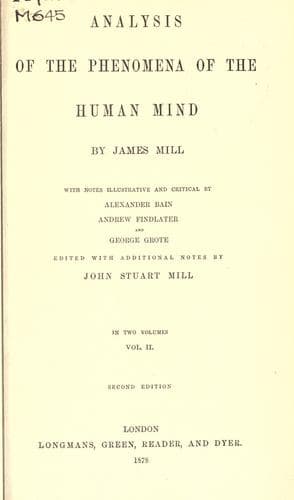
Analysis of the Phenomena of the Human MindMill, James
PhilosophyPhilosophy
Analysis of the Phenomena of the Human Mind
Mill, James
Psychology
I take MEMORY first, and JUDGMENT last, from no other principle of
arrangement, than facility of {342} exposition; and I have in this
way found it convenient to treat of JUDGMENT as a case of
BELIEF.[95]
[Editor's footnote 95: How is it possible to treat of Belief without
including in it Memory and Judgment? Memory is a case of belief. In
what does Memory differ from Imagination, except in the belief that
what it represents did really take place? Judgment, in its popular
acceptation, is Belief resulting from deliberate examination, in
other words, Belief grounded on evidence: while in its philosophical
sense it is coextensive, if not synonymous, with Belief itself. I do
not know how it is possible to distinguish a judgment from any other
process of the mind, except by its being an act of belief.--_Ed._]
We begin as usual with the simplest cases. These are, the case of a
simple sensation, and the case of a simple idea. When we have a
sensation, we BELIEVE that we have it; when we have an idea, we
BELIEVE that we have it.
But, to have a sensation, and to believe that we have it, are not
distinguishable things. When I say "I have a sensation," and say,
"I believe that I have it," I do not express two states of
consciousness, but one and the same state. A sensation is a feeling;
but a feeling, and the belief of it are the same thing. The
observation applies equally to ideas. When I say I have the idea of
the sun, I express the same thing exactly, as when I say, that I
believe I have it. The feeling is one, the names, only, are two.[96]
[97]
[Bain's footnote 96: In the case of a present reality, belief has no
place; it can be introduced only by a fiction or a figure. The
believing state comes into operation when something thought of is
still remote, and attainable by an intermediate exertion. The fact
"I see the sun" is full fruition: the fact that I can see the sun by
going out of doors affords scope for belief or disbelief.--_B._]
[Editor's footnote 97: The difference between Mr. Bain and the
author is but in language and classification. It is necessary for
the reader of the Analysis to remember, that the author uses the
word Belief as the most general term for every species of conviction
or assurance; the assurance of what is before our eyes, as well as
of that which we only remember or expect; of what we know by direct
perception, as well as of what we accept on the evidence of
testimony or of reasoning: all this we are convinced or persuaded
of; all this, in the author's language, we believe. Mr. Bain, on the
other hand, like Sir William Hamilton and many others, restricts the
term to those cases of conviction which are short of direct
intuition.--_Ed._]
Public-domain text, read in full here on John Shaqi.
Reviews
Reviews
No reviews yet
Be the first to share your thoughts on this work.
Elsewhere in the archive
Join the Discussion
Join the discussion
Sign in to leave a comment or review.
Sign InorCreate an account