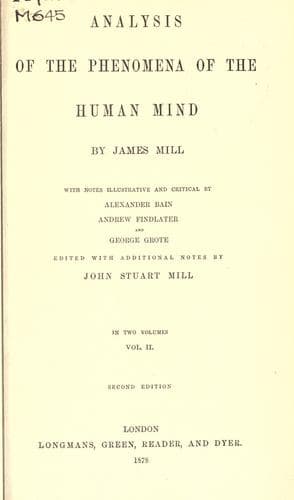
Analysis of the Phenomena of the Human MindMill, James
PhilosophyPhilosophy
Analysis of the Phenomena of the Human Mind
Mill, James
Psychology
Not only are we, during the whole period of our lives, witnesses of
an incessant train of events; that is, of antecedents and
consequents, between which, for the greater part, the order is
constant; but these constant conjunctions are, of all things in the
world, what we are {351} the most deeply interested in observing;
for, on the knowledge of them, all our power of obtaining good and
avoiding evil depends. From this, it necessarily follows, that
between none of our ideas is the association more intimate and
intense, than between antecedent and consequent, in the order of
events. Whenever we perceive an event, the mind instantly flies to
its antecedent. I hear words in the street; _event_: some one, of
course, is making them; _antecedent_. My house is broken, and my
goods are gone; _event_: a thief has taken them; _antecedent_. This
is that remarkable case of association, in which the combination is
_inseparable_; a case of so much importance in explaining some of
the more mysterious phenomena of thought. Other instances of this
remarkable phenomenon, to which we have already had occasion to
advert, are, the sight of an object, and the ideas of its distance,
its extension, and figure; the idea of colour, and the idea of
extension; the idea of an object, and the idea of position and
unity; the idea of one of my sensations, and the idea of myself. In
no instance is this inseparable association more perfect, or its
consequences more important, than in that between an event, and its
antecedent. We cannot think of the one without thinking of the
other. The two ideas are forced upon us at the same time; and by no
effort of ours can they be disjoined. So necessarily, from the first
moment of experience, are we employed in observing the constant
conjunctions of events; and so deeply are we interested, in looking
out for, and knowing the constant antecedent of every event, that
the association becomes part of our being. The perception, or the
idea, of an event, instantly brings up {352} the idea of its
constant antecedent; definite and clear, if the antecedent is known;
and indefinite and obscure, if it is unknown. Still, the idea of an
event, of a change, without the idea of its cause, is impossible.
That a cause means, and can mean nothing to the human mind, but
constant antecedent, is no longer a point in dispute.[99]
[Editor's footnote 99: Here again the author takes too sanguine a
view of the amount of agreement hitherto attained among metaphysical
philosophers. "That a cause means, and can mean, nothing to the
human mind but constant antecedent" is so far from being "no longer
a point in dispute" that it is denied with vehemence by a large
numerical majority of philosophers; and its denial is perhaps the
principal badge of one of the two schools which at this, as at most
other times, bisect the philosophical world--the intuitional school
and the experiential--_Ed._]
Public-domain text, read in full here on John Shaqi.
Reviews
Reviews
No reviews yet
Be the first to share your thoughts on this work.
Elsewhere in the archive
Join the Discussion
Join the discussion
Sign in to leave a comment or review.
Sign InorCreate an account