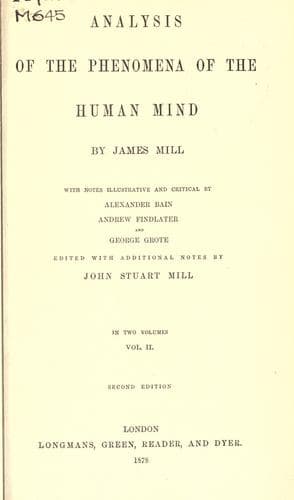
Analysis of the Phenomena of the Human MindMill, James
PhilosophyPhilosophy
Analysis of the Phenomena of the Human Mind
Mill, James
Psychology
Of this remarkable case of association, that which we call "Our
Belief in External Objects" is one of the most remarkable instances.
Of the sensations, of sight, of handling, of smell, of taste, which
I have from a rose, each is an event; with each of those events, I
associate the idea of a constant antecedent, a cause; that cause
unknown, but furnished with a name, by which it may be spoken of,
namely, quality; the quality of red, the cause of the sensation red;
the qualities of consistence, extension and figure, the causes of
the sensations of handling; the qualities of smell and taste, the
causes of the sensations of smell and taste. Such is one part of the
process of association in this case. Another is that by which the
ideas of those sensations are so intimately united, as to appear not
several ideas, but one idea, the idea of a rose. We have now two
steps of association; that {353} of the several sensations into one
idea; that of the several sensations each with a separate cause. But
we do not stop here; for, as in a train of events, consisting of
several links, A, B, C, D, and so on, though C is the antecedent or
cause of D, it is itself the consequent or effect of B; and in all
cases, when we have found the cause of any particular event, we have
still to find out what was the cause of that cause. In this manner,
when our habit of association has carried us from our sensations to
the causes of them, the same habit carries us still farther.
As each of our sensations must have a cause, to which, as unknown,
we give the name quality; so each of those qualities must have a
cause. And as the ideas of a number of sensations, concomitant in a
certain way, are combined into a single idea; as that of rose, that
of apple; the unity, which is thus given to the effects, is of
course transferred to the supposed causes, called qualities: they
are referred to a common cause. To this supposed cause of supposed
causes, we give a name; and that name is the word _Substratum_.
It is obvious, that there is no reason for stopping at this
_Substratum_; for, as the sensation suggested the quality, the
quality the substratum, the substratum as properly leads to another
antecedent, another substratum, and so on, from substratum to
substratum, without end. These inseparable associations, however,
rarely go beyond a single step, hardly ever beyond two. The
Barbarian, in accounting for the support of the earth, placed it on
the back of a great elephant, and the great elephant on the back of
a great tortoise; but neither himself, nor those whom he {354}
instructed, were carried by their habits of association any
farther.[100]
Public-domain text, read in full here on John Shaqi.
Reviews
Reviews
No reviews yet
Be the first to share your thoughts on this work.
Elsewhere in the archive
Join the Discussion
Join the discussion
Sign in to leave a comment or review.
Sign InorCreate an account