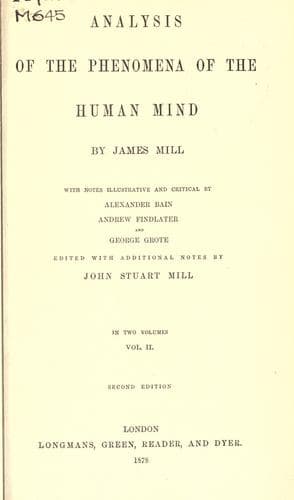
Analysis of the Phenomena of the Human MindMill, James
PhilosophyPhilosophy
Analysis of the Phenomena of the Human Mind
Mill, James
Psychology
[Editor's footnote 100: It is a question worth considering, why that
demand for a cause of everything, which has led to the invention of
so many fabulous or fictitious causes, so generally stops short at
the first step, without going on to imagine a cause of the cause.
But this is quite in the ordinary course of human proceedings. It is
no more than we should expect, that these frivolous speculations
should be subject to the same limitations as reasonable ones. Even
in the region of positive facts in the explaining of phenomena by
real, not imaginary, causes--the first semblance of an explanation
generally suffices to satisfy the curiosity which prompts the
inquiry. The things men first care to inquire about are those which
meet their senses, and among which they live; of these they feel
curious as to the origin, and look out for a cause, even if it be
but an abstraction. But the cause once found, or imagined, and the
familiar fact no longer perplexing them with the feeling of an
unsolved enigma, they do not, unless unusually possessed by the
speculative spirit, occupy their minds with the unfamiliar
antecedent sufficiently to be troubled respecting it with any of the
corresponding perplexity.--_Ed._]
Such appear to be the elements included in our belief of the
existence of objects acting on our senses. We have next to unfold
the case of belief in the present existence of objects not acting on
our senses.
Of this Belief, there are two cases: 1, Belief in the existence of
objects, which we have not perceived; 2, Belief in the existence of
objects, which we have perceived.
The first of these, is a case of the Belief in testimony; which is
to be explained hereafter. What we are to examine at the present
moment, then, is, our Belief in the existence of objects, which,
though not {355} now present to our senses, have been so at a
previous time. Thus, I believe in the present existence of St.
Paul's, which I saw this morning.
In tracing the elements of this Belief, it is obvious in the first
place, that in so far as it is founded on my past sensations, memory
is concerned in it. But Memory relates to _past_ events, Belief in
which, is to be considered under a following head. This part of the
development, therefore, we postpone.
But, beside Memory, what other element is concerned in it? There is
evidently an anticipation of the future. In believing that St.
Paul's exists, I believe, that whenever I am in the same situation,
in which I had perception of it before, I shall have perception of
it again. But this Belief in future events, is also a case, which
remains to be considered under a subsequent head. This, therefore,
is another part of the development, which must be postponed.
Public-domain text, read in full here on John Shaqi.
Reviews
Reviews
No reviews yet
Be the first to share your thoughts on this work.
Elsewhere in the archive
Join the Discussion
Join the discussion
Sign in to leave a comment or review.
Sign InorCreate an account