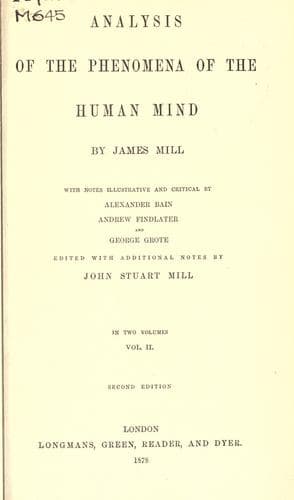
Analysis of the Phenomena of the Human MindMill, James
PhilosophyPhilosophy
Analysis of the Phenomena of the Human Mind
Mill, James
Psychology
"That the fear, as a mere emotion, should be more intense, according
to the greatness of the object, might indeed be expected; and if
this were all, there would be nothing wonderful in the state of mind
which I have now described. But there is not merely a greater
intensity of fear, there is, in spite of reflection, a greater
belief of probability of attack. There is fear, in short, and fear
to which we readily yield, when otherwise all fear would have seemed
absurd. The reason of this it will perhaps not be difficult for you
to discover, if you remember the explanations formerly given by me,
of some analogous phenomena. The loss of what is valuable in itself,
is of course a great affliction. The slightest possibility of such
an evil makes the evil itself occur to us, as an object of
conception, though not at first, perhaps, as an object of what can
be termed fear. Its very greatness, however, makes it, when thus
conceived, dwell longer in the mind; and it cannot dwell long, even
as a mere conception, without exciting, by the common influence of
suggestion, the different states of mind, associated with the
conception of any great evil; of which associate or resulting
states, in such circumstances, fear is one of the most constant and
prominent. The fear is thus readily excited as an associate feeling;
and when the fear has once been excited, as a mere associate
feeling, it continues to be still more readily suggested again, at
every moment, by the objects that suggested it, and with the
perception or conception of which it has recently co-existed. There
is a remarkable analogy to this process, in the phenomena of
giddiness, to which I have before more than once alluded. Whether
the height on which we stand, be elevated only a few feet, or have
beneath it a precipitous abyss of a thousand fathoms, our footing,
if all other circumstances be the same, is in itself equally sure.
Yet though we look down, without any fear, on the gentle slope, in
the one case, we shrink back in the other case with painful dismay.
The lively conception of the evil which we should suffer in a fall
down the dreadful descent, which is very naturally suggested by the
mere sight of the precipice, suggests and keeps before us the images
of horror in such a fall, and thus indirectly the emotions of fear,
that are the natural accompaniments of such images, and that but for
those images never would have arisen. We know well, on reflection,
that it is a footing of the firmest rock, perhaps, on which we
stand, but in spite of reflection, we feel, at least, at every other
moment, as if this very rock itself were crumbling or sinking
beneath us. In this case, as in the case of the traveller, the
liveliness of the mere conception of evil that may be suffered,
gives a sort of temporary probability to that which would seem to
have little likelihood in itself, and which derives thus from mere
imagination all the terror that is falsely embodied by the mind in
things that exist around.
Public-domain text, read in full here on John Shaqi.
Reviews
Reviews
No reviews yet
Be the first to share your thoughts on this work.
Elsewhere in the archive
Join the Discussion
Join the discussion
Sign in to leave a comment or review.
Sign InorCreate an account