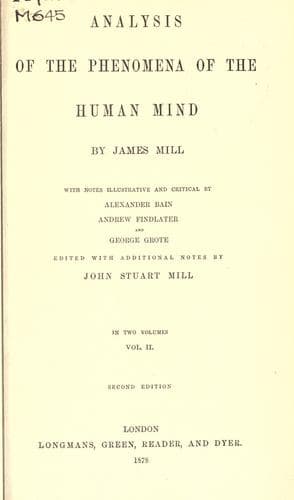
Analysis of the Phenomena of the Human MindMill, James
PhilosophyPhilosophy
Analysis of the Phenomena of the Human Mind
Mill, James
Psychology
"It is not, then, any simple ratio of probabilities which regulates
the rise of our hopes and fears, but of these combined with the
magnitude or insignificance of the objects."--_Lectures on the
Philosophy of the Human Mind_. Lecture LXV., vol. iii., p. 345--347.
2d ed.
Notwithstanding this, the ideas of Dr. Brown were so far from being
clear and settled on the subject, that in the same work, Lecture
VI., v. i., p. 115, he seems to affirm, that belief cannot be
accounted for by association, but must be referred to instinct;
though it is necessary to use the word _seems_, for it is not
absolutely certain that he does not by _instinct_ mean
association.--(_Author's Note_.)]
{375} From these illustrations, then, it does not appear that the
anticipation of the future from the past, contains in it any thing
peculiar. So far from standing by itself, a phenomenon _sui generis_
it is included in one of the most general of the laws of the human
mind. When Professor Stewart, therefore, and other writers, erect it
into an object of wonder, a prodigy, a thing falling within no
general rule; and tell us they can refer it to nothing but instinct;
which is as much {376} as to say, to nothing at all; the term
instinct, in all cases, being a name for nothing but our own
ignorance; they only confess their failure in tracing the phenomena
of the mind to the grand comprehensive law of association; to the
admission of which, in its full extent, they seem to have had a most
unaccountable, and a most unphilosophical aversion;--as if that
simplicity, according to which one law is found {377} included in a
higher, and that in a yet higher, till we arrive at a few which seem
to include the whole, were not as much to be expected in the world
of mind, as in the world of matter.[12*]
[Mill's footnote 12: Locke, at a period subsequent to the
publication of his Essay, seems to have become more sensible of the
importance of association. These are his words:--"I think I shall
make some other additions to be put into your Latin translation, and
particularly concerning the connexion of ideas, which has not, that
I know, been hitherto considered, and has, I guess, a greater
influence upon our minds, than is usually taken notice
of."--_Locke_, _Lett. to Molineux_, _April_ 26_th_,
1695.--(_Author's Note_.)
[When Locke wrote the letter here quoted, he had not yet written the
chapter of his Essay which treats of the Association of Ideas. That
chapter did not appear in the original edition, but was first
inserted in the fourth, published in 1690. The intention, therefore,
which he expressed to Molineux, has received its fulfilment; and the
passage quoted further on in the text, is part of the "addition"
which he contemplated.--_Ed._]]
Public-domain text, read in full here on John Shaqi.
Reviews
Reviews
No reviews yet
Be the first to share your thoughts on this work.
Elsewhere in the archive
Join the Discussion
Join the discussion
Sign in to leave a comment or review.
Sign InorCreate an account