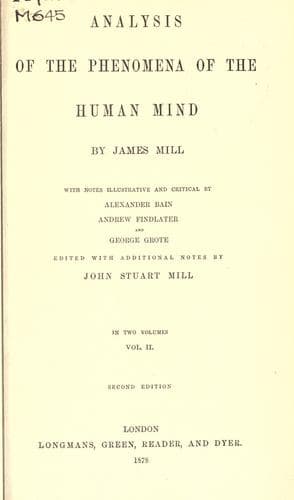
Analysis of the Phenomena of the Human MindMill, James
PhilosophyPhilosophy
Analysis of the Phenomena of the Human Mind
Mill, James
Psychology
"This wrong connexion, in our minds, of ideas in themselves loose
and independent of one another, has such an influence, and is of so
great force, to set us awry in our actions, as well moral as
natural, passions, reasonings, and notions themselves; that perhaps
there is not any one thing that deserves more to be looked after.
"The ideas of goblins and sprights have really no more to do with
darkness than light. Yet let but a foolish maid inculcate these
often in the mind of a child, and raise them there together,
possibly he shall never be able to separate them again so long as he
lives; but darkness shall ever afterwards bring with it those
frightful ideas, and they shall be so joined, that he can no more
bear the one than the other.
"A man receives a sensible injury from another; thinks on the man
and that action over and over; and by ruminating on them strongly,
or much in his mind, so cements those two ideas together, that he
makes them almost one."
"When this combination is settled, and while it {380} lasts, it is
not in the power of reason to help us and relieve us from the
effects of it. Ideas in our minds, when they are there, will operate
according to their nature and circumstances. And, here, we see the
cause why Time cures certain affections, which reason, though in the
right, has not power over, nor is able, against them, to prevail
with those who are apt to hearken to it in other cases."
After adducing various examples, to illustrate the effect of these
associations, in producing both vicious affections, and absurd
opinions, he thus concludes:
"That which thus captivates our reasons, and leads men blindfold
from common sense, will, when examined, be found to be what we are
speaking of. Some independent ideas of no alliance to one another,
are, by education, custom, and the constant din of their party, so
coupled in their minds, that they always appear there together; and
they can no more separate them in their thoughts, than if there were
but one idea; and they operate as if they were so. This gives sense
to jargon, demonstration to absurdity, and consistency to nonsense;
and is the foundation of the greatest, I had almost said, of all,
the errors in the world."
Public-domain text, read in full here on John Shaqi.
Reviews
Reviews
No reviews yet
Be the first to share your thoughts on this work.
Elsewhere in the archive
Join the Discussion
Join the discussion
Sign in to leave a comment or review.
Sign InorCreate an account